
In This Article
- Quick answer
- How a sarcastic comment became a public accusation
- Why online crowds get identification wrong so often
- Share with care, post with purpose
- What to do if you are falsely accused online
- What this means for organizations
- Frequently asked questions
- Need help with a viral accusation?
Quick answer
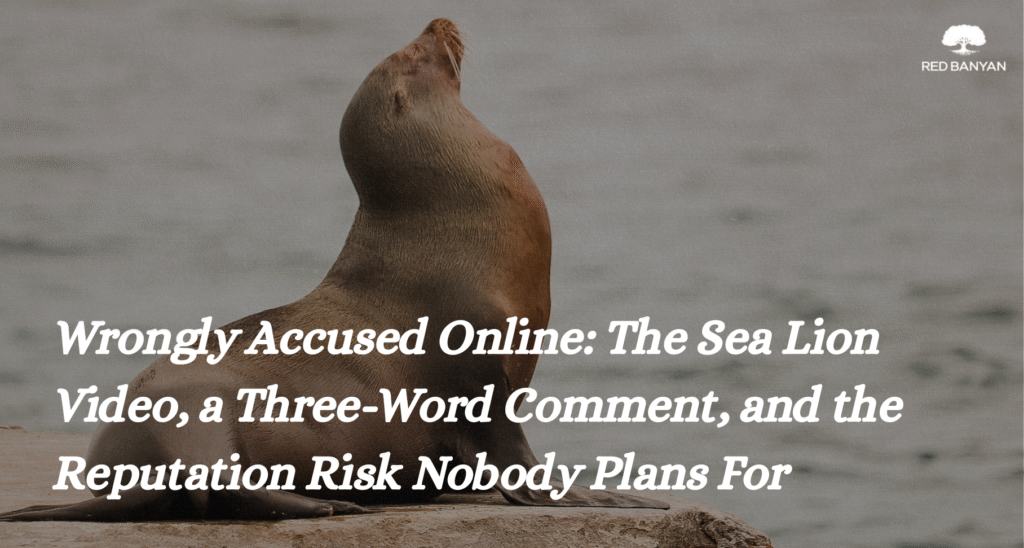
An 18-year-old San Diego resident named Ryland Cuttitta was wrongly identified by social media users as the man seen kicking a sea lion in a viral video at La Jolla Cove. He was never at the scene. Internet users misread a sarcastic three-word Instagram comment he left under a repost of the video, treated it as a confession, published his home address, and sent his family death threats. The case is a clear illustration of how quickly an online crowd can assign guilt, and how difficult it is to reverse that judgment once it spreads.
A video recorded late on July 22 showed a young man kicking and chasing a sea lion resting on a seawall at Point La Jolla in San Diego. The footage drew immediate outrage, condemnation from animal welfare groups, and a federal investigation by NOAA Fisheries, which is examining the incident as a possible violation of the Marine Mammal Protection Act. Harassing a sea lion under that law can carry civil penalties reaching roughly $36,000 along with the possibility of jail time.
Federal investigators have still not publicly identified the person in the video. The internet decided it already had.
How a sarcastic comment became a public accusation
Ryland Cuttitta, 18, left a short comment beneath a repost of the clip. He wrote that the kicking was “clearly self defense,” intending the remark as mockery of the attacker. Other users read the comment as an admission and began circulating his name as the person in the footage.
“My name is Ryland Cuttitta, and I was not part of the video. I was not even there or associated with it in any way. It all came from an Instagram comment,” he told NBC 7 San Diego.
What followed was fast and severe. According to reporting from NBC 7 and Yahoo News, the family’s home address was posted publicly, they received violent and obscene messages, and death threats were left on voicemail. The family filed a report with the San Diego Police Department and made contact with the NOAA investigator handling the animal abuse case. Cuttitta made his Instagram account private to slow the harassment.
He also pointed out something that any careful viewer could have checked. “Obviously in the video you can see that the kid is blonde with a buzz cut. My hair is dark and longer than that,” he said.
His mother, Susan Cuttitta, framed the experience as a warning about online vigilante justice. “Maybe this is advocacy work on our part to now spread the word about the dangers of social media,” she said.
Why online crowds get identification wrong so often
Crowdsourced accusation has a documented failure rate, and the consequences fall on people with no ability to defend themselves at the speed of the accusation.
The most cited example remains the 2013 Boston Marathon bombing, when Reddit users running a crowdsourced investigation named Brown University student Sunil Tripathi as a suspect. Tripathi had gone missing weeks before the bombing and had no connection to it. His family was overwhelmed with harassment while searching for him. Reddit later issued a public apology, with its general manager acknowledging that activity on the platform “fueled online witch hunts and dangerous speculation which spiraled into very negative consequences for innocent parties.” Tripathi was found dead shortly afterward.
The speed problem is measurable. A study published in Science by MIT researchers analyzed roughly 126,000 stories shared on Twitter over eleven years and found that false information reached 1,500 people about six times faster than accurate information, and that falsehoods were 70 percent more likely to be retweeted. Corrections travel slowly. The original accusation keeps traveling.
For an individual, this asymmetry is the entire problem. A name attached to an accusation gets indexed, screenshotted, and reposted. A retraction reaches a fraction of the original audience.
Share with care, post with purpose
Red Banyan founder and CEO Evan Nierman has made this exact risk the subject of his TEDx talk, “How we risk our lives online.” His guidance is simple and worth repeating in light of this case: share with care, and post with purpose.
The Cuttitta situation demonstrates why that advice matters even for people acting in good faith. He was doing what millions of people do every day, which is drop a quick sarcastic line into a comment thread. Sarcasm carries no tone of voice in text, and his landed in front of an audience actively hunting for a suspect and primed to read anything as a lead. Three words, written in seconds, produced doxxing and death threats.
The practical takeaway is that anything posted online can be lifted out of its context and used to build a story about you, including when you have done nothing wrong. That applies to private individuals, executives, employees, and brands alike.
What to do if you are falsely accused online
Anyone can end up in this position with no warning. The response in the first 48 hours has an outsized effect on how long the accusation lasts.
- Document everything before it disappears. Screenshot the posts, comments, accounts, timestamps, and any threatening messages. Preserve voicemails. This record becomes the basis for platform reports, police reports, and any legal action.
- Report threats to law enforcement. Doxxing and threats of violence are criminal matters in most jurisdictions. Filing a report creates an official record even when an immediate arrest is unlikely.
- Reduce your exposure without deleting your history. Setting accounts to private limits new harassment. Mass-deleting posts can look like an attempt to hide something and destroys evidence you may need.
- Correct the record once, clearly, in one place. A single factual statement, with verifiable details, gives journalists and platforms something to cite. Repeated arguing in comment threads extends the story’s life.
- Report platform violations systematically. Harassment, doxxing, and coordinated pile-ons violate the terms of service of every major platform. Coordinated reporting gets results that scattered individual reports do not.
- Address the search results. Once the accusation is indexed, it becomes the first thing a school, employer, or client sees. Suppressing and displacing that content is a separate discipline from the crisis response itself.
- Get help before the story hardens. Reputational damage compounds with time. The window in which a correction can outrun an accusation is measured in hours.
What this means for organizations
Companies face the same dynamic, usually at greater scale. A single post can generate a coordinated campaign, and the volume of that campaign often has little relationship to the underlying facts.
Red Banyan handles these situations regularly. In one of our recent engagements, a food service business faced a fast-moving cancellation campaign after a video of its operations went viral. Our response combined rapid, accountable communication with careful calibration of how much to say and where, so the company met the moment without extending the story’s lifespan through overreaction. At the same time, the team identified and reported reviews that were part of the pile-on rather than genuine customer experiences, and had them removed. The person whose post started the campaign eventually engaged directly with the business, walked back the original criticism, and publicly praised how the company handled the situation.
That outcome required moving quickly, telling the truth, and treating the manufactured portion of the backlash as a separate problem from the legitimate criticism.
Frequently asked questions
Who was wrongly accused in the La Jolla sea lion video?
Ryland Cuttitta, an 18-year-old from San Diego, was wrongly identified by social media users as the man in the video. He has said he was not present at La Jolla Cove and was not involved in any way.
What comment caused the misidentification?
He posted “clearly self defense” under a repost of the video as sarcasm directed at the attacker. Other users interpreted it as a confession.
Has the actual person in the video been identified?
No. As of early August 2026, NOAA’s Office of Law Enforcement is continuing its investigation and has not publicly named a suspect.
Is it illegal to kick a sea lion?
Yes. Sea lions are protected under the federal Marine Mammal Protection Act. Harassment can bring civil penalties in the range of $36,000 and the possibility of up to a year in prison.
What should I do if strangers online accuse me of something I did not do?
Document the posts and threats, report threats to law enforcement, tighten your account privacy without deleting evidence, issue one clear factual correction, report platform violations, and get professional help addressing search results before the accusation becomes the top result for your name.
Need help with a viral accusation?
Red Banyan works with individuals, executives, and organizations facing online backlash, misidentification, doxxing, and coordinated cancellation campaigns. Contact our team for a confidential conversation.