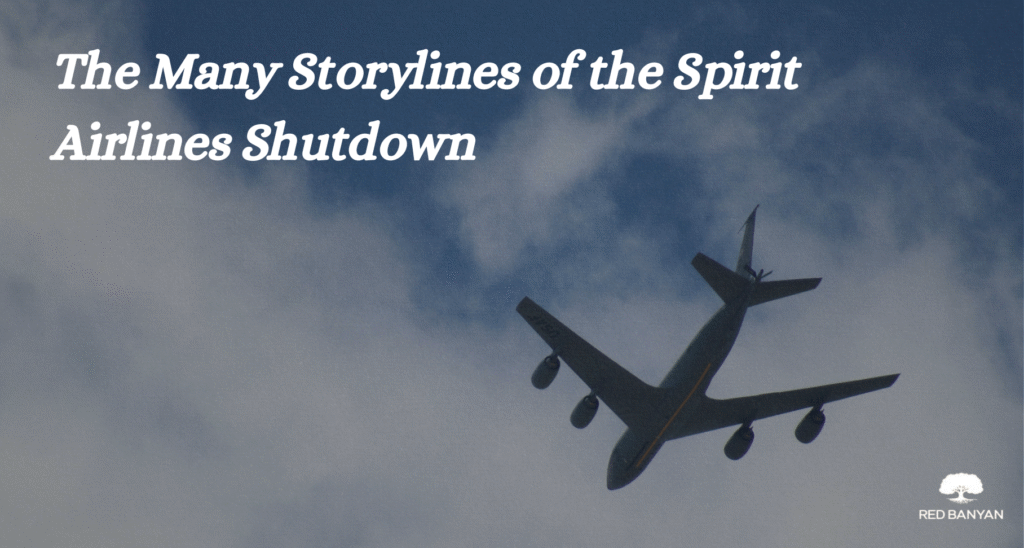

At 3 AM on May 2, 2026, the Association of Flight Attendants sent a message to its Spirit Airlines members: “We are delivering the hardest news of our lives. Spirit will cease operations.” By the time most of America woke up, the airline was gone — 34 years of service, 17,000 jobs, and hundreds of bright yellow planes, all grounded overnight. The shutdown notice posted at airports was characteristically blunt: “All flights have been canceled, and customer service is no longer available.”
That last line became its own cultural artifact within hours. Stephen Colbert opened The Late Show with mock grief over losing a reliable bit: “Now I won’t have Spirit Airlines jokes? Quick, somebody check on Arby’s: the Spirit Airlines of shaved beef.” Seth Meyers noted that “only Spirit could cancel all flights and tell customers not to come to the airport and also describe it as an ‘orderly wind down'” — before adding that compared to a normal Spirit flight, it kind of was.
What happened over the next 72 hours wasn’t really one news story. It was a dozen of them, playing out simultaneously across different platforms, audiences, and emotional registers — each with its own protagonist, villain, and conclusion. Together, they’re a snapshot of how a brand event actually moves in 2026. And they raise questions every communications team should be sitting with right now.
Punchline to Eulogy in a Single Scroll
Spirit had long occupied a rare cultural position: a universal punchline. The fees, the seats, the gate-side chaos — it was comedy shorthand. But as late-night hosts wrote their send-offs, something else was happening simultaneously on the other side of the feed. Former employees flooded Threads, Instagram, and X with tributes that reframed the entire company in a single scroll. Pilot Jason Smith: “Here’s to 19+ years, lifelong friends made and the best job this guy ever had.” Flight attendant Temptest Nicole: “This isn’t the ending I imagined, but it’s a chapter I’ll always be proud of.”
The tonal whiplash between comedy and elegy, running in parallel across the same weekend, captures something important about how brand crises move now. A story doesn’t travel in a straight line from event to coverage to public opinion. It fragments immediately into parallel narratives reaching different audiences with different emotional conclusions.
Meanwhile, People magazine found the human-interest hook in a wedding photographer mid-flight to a ceremony when the airline shut down. A 72-year-old man on a fixed income learned his flight home was gone only after returning his rental car at the curb. Passengers arriving at Fort Lauderdale were still being dropped off for flights that no longer existed, learning the news curbside. These weren’t statistics. They were faces — and they added emotional weight to what might otherwise have been processed as corporate trivia.
What Separates Good Crisis-Jacking from Bad
Within hours, the industry response was in motion. JetBlue offered $99 rescue fares. American rolled out “distressed passenger” rates. Frontier offered up to 50% off across more than 100 routes it shared with Spirit. United, Delta, Allegiant, and Avelo all joined. Fast, comprehensive, calibrated to stranded passengers who needed a flight, not a press release.
But the response that traveled furthest didn’t involve a fare at all. Captain Jon Jackson had planned to fly his final retirement trip on a Spirit aircraft. Instead he ended up as a passenger in the back of a Southwest flight, traveling home to Baltimore alongside his son, a Southwest first officer. His son mentioned to the cockpit crew what the day was supposed to mean. A plan was set in motion mid-flight. When the aircraft landed, Baltimore Airport Fire & Rescue met it with a water cannon salute. Ground crews waited at the gate with cheers and champagne. A gate agent announced: “Ladies and gentlemen, Mr. Jon Jackson.” He stepped off the jet bridge and said: “Very overwhelming. As Spirit goes down, this is a sad day — and you guys made it incredible.” Southwest posted it on Instagram. It went viral immediately.
The rescue fares were transactional — useful and appropriate. The water cannon salute was human. It didn’t have a booking deadline. That distinction is the line between crisis-jacking that earns goodwill and the kind that reads as opportunistic: audiences are sophisticated about whether a brand is showing up for people or for market share.
When Meme Culture Meets Populist Organizing
The most unexpected storyline came from Hunter Peterson, a 22-year-old voice actor, who posted a TikTok shortly after the shutdown: “We could buy Spirit Airlines.” By Tuesday morning, his site claimed $132 million in non-binding pledges from over 156,000 people, targeting $1.75 billion. The framing was pointedly populist: “Private equity is already circling the wreckage. The passengers, the workers, and the communities Spirit served can take it back.”
Fortune pointed out the premise had a significant problem — private equity wasn’t actually Spirit’s villain. No one wanted to buy the airline at the price its creditors needed. Spirit’s CEO told CNBC the airline had “just kind of run out of runway.” But none of that mattered to 156,000 people who pledged anyway. What Peterson tapped into wasn’t a business plan — it was a sentiment. The feeling that institutions fail ordinary people while financial actors walk away. The campaign reframed a bankruptcy proceeding as a civic moment and briefly introduced a chaotic new variable into a courtroom expecting an orderly liquidation. A 22-year-old with a TikTok account moved faster than the creditors, competitors, and politicians combined.
The Political Storyline and Where Spirit Lost the Narrative
Before the planes had stopped moving, the finger-pointing had started. Trump allies blamed the Biden-era DOJ’s block of the JetBlue-Spirit merger. Senator Warren pointed to fuel data: Spirit’s restructuring plan assumed jet fuel at $2.24 per gallon; by late April, driven by the Iran war, it had climbed to $4.51. Transportation Secretary Duffy announced federal relief at a Saturday news conference and simultaneously blamed “Joe Biden and Pete Buttigieg.” Trump himself blamed Obama for blocking a Spirit merger with People Express — a company that ceased operations in 1987.
The underlying collapse was years in the making: two bankruptcies, a blocked merger, a failed bailout bid, and fuel costs that had nearly doubled. CNN’s diagnosis was blunter: too many passengers hated flying the airline. But the communications failure was its own problem. The overnight shutdown notice — no advance warning to anyone — created a vacuum that every other actor rushed to fill. Late-night hosts wrote the comedy send-off. Employee tributes provided the elegy. Human-interest outlets provided the faces. Competitors provided the fares and emotional center. Politicians provided the blame. A TikTok creator provided the populist reframe. USA Today was reporting on what happens to the fleet while Spirit itself appeared in all those stories as a supporting character, rarely the author of its own.
What This Means for Communications Teams
The Spirit shutdown is extreme, but its dynamics are increasingly ordinary. A major brand moment now fragments immediately, and the press-release version of events is one of many simultaneous narratives — often not the most powerful one.
A few things this case makes clear: The narrative window is measured in hours, not days. Silence doesn’t stabilize a crisis — it creates inventory for other storytellers. Different audiences process different versions of your crisis simultaneously and won’t converge on a single conclusion. The most durable brand moments come from people, not promotions. And influencers and online communities are now actors, not observers — Hunter Peterson didn’t cover the Spirit shutdown, he intervened in it.
The WSJ noted Spirit’s collapse means higher fares for everyone — the competitive pressure Spirit kept on routes across the country is gone, and the passengers who relied on ultra-low fares are the ones who’ll feel it most. Those are the durable consequences. The narratives were the way a fragmented media environment processed a complicated collapse in real time. They weren’t the story. They were the stories. Understanding the difference is increasingly central to what it means to manage a brand in a crisis.
Because when the moment arrives — and it will — the story will move without you. The only question is whether you’re prepared to participate in it.
In today’s environment, experienced crisis PR firms like Red Banyan® play a critical role in helping organizations respond in real time, manage fragmented narratives, and protect their reputation when it matters most.
Contact us now or schedule a free confidential consultation.