
Artificial intelligence can help companies operate faster, reduce costs and compete more effectively. But when it influences who keeps a job, efficiency is no longer the only concern. Fairness, transparency and corporate credibility are also at stake.
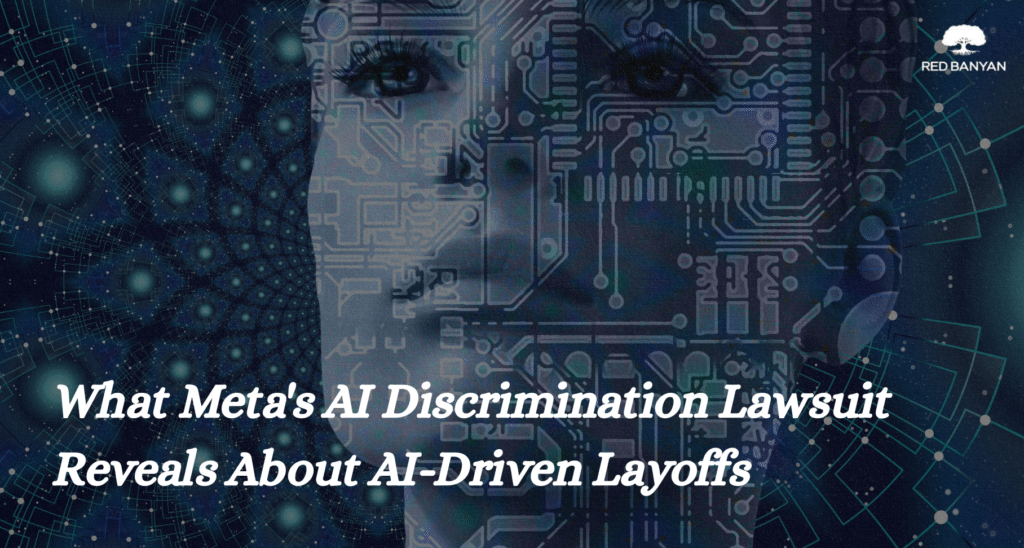
That tension is at the center of a lawsuit brought by 26 Meta employees who allege they were targeted for layoffs because they had disabilities or took medical or family leave. Reuters described it as the first case specifically challenging the alleged use of artificial intelligence to select workers for layoffs.
The allegations have not been proven, and Meta strongly denies them. Still, the case raises urgent questions about AI employment discrimination, algorithmic bias in employment and the growing corporate reputation risks of AI-driven layoffs.
When AI Productivity Monitoring Cannot See the Whole Person
Automated performance measurements may record activity without understanding the circumstances behind it.
The employees claim Meta consulted AI-assisted systems that tracked productivity and AI token usage, potentially disadvantaging workers whose protected absences naturally resulted in less digital activity.
According to the lawsuit, the systems allegedly included “Metamate,” a large language model assistant; an employee-trained “second brain” that tracked communications and documents; and a productivity score derived from keystrokes, screen content, emails and browser history.
Meta denies using AI activity to identify workers for termination or conduct performance reviews. The company says humans made every decision connected to nearly 8,000 layoffs announced earlier in 2026.
That distinction matters, but it does not resolve the broader concerns surrounding AI productivity monitoring.
An automated system may detect fewer emails, less keyboard activity or reduced use of internal AI tools. What it may not understand is that an employee was receiving medical treatment, recovering from surgery, managing a disability or taking legally protected family leave.
Can AI discriminate against employees on medical leave without anyone deliberately programming it to do so? The answer may depend on whether protected absences are properly excluded from productivity calculations and whether leaders understand the limitations of automated employment decision tools.
If a system cannot distinguish between poor performance and a protected absence, apparently neutral data can produce deeply unfair conclusions.
Why Proving AI Employment Discrimination Is So Difficult
Employees may be forced to challenge systems they cannot inspect using evidence controlled by their employer.
The Meta case highlights the severe information imbalance present in many AI employment disputes.
Employees generally do not know what information a system collected, how different factors were weighted or whether protected leave was excluded. They may not know which managers viewed an AI-generated score, whether that score influenced a ranking or how heavily leadership relied on automated recommendations.
The company, meanwhile, controls the technology, internal communications and much of the decision-making record.
This creates a major AI accountability problem in the workplace. Employees may suspect that algorithmic bias influenced an adverse decision, but they often have little ability to prove it without access to internal data.
A company can say that a person made the final determination. Employees may still have no way of knowing what information shaped that person’s judgment.
A judge declined to immediately stop the Meta terminations, although the court may reconsider longer-term relief if employees uncover evidence that AI was used improperly. The legal process may eventually provide greater clarity. The reputational questions are already present.
Human Approval Is Not Human Oversight
A manager’s signature does not automatically make an opaque recommendation accurate or fair.
Companies increasingly defend AI-assisted layoffs by emphasizing that human decision-makers made the final call. Human involvement alone, however, does not establish meaningful human oversight of AI.
If a manager relies on an AI performance score without understanding how it was produced, human review may amount to little more than a rubber stamp. If decision-makers do not test the system’s assumptions, identify missing context or challenge questionable outputs, the presence of a person at the end of the process offers limited protection.
Genuine human oversight requires understanding, scrutiny and a willingness to reject an automated recommendation.
Executives must know what their technology is measuring. They must also understand what it cannot measure.
An algorithm cannot fully assess loyalty, resilience, institutional knowledge or the broader value of an employee’s contributions unless those qualities have been converted into data. Even then, the result may be incomplete or misleading.
AI can support human judgment. It should not replace it.
Private Arbitration Can Conceal Public Risk
The absence of visible lawsuits does not prove that workplace AI systems are fair.
The Meta employees reportedly signed agreements requiring employment disputes to be handled through individual arbitration. That may limit their ability to pursue a class action, appear before a jury or combine evidence from multiple workers publicly.
Arbitration can also keep documents, testimony and findings confidential. Information uncovered in one employee’s case may never help another worker who believes the same system affected them.
This creates a hidden legal and reputational risk. Complaints may accumulate beneath the surface without producing major news coverage or public litigation. Leadership may mistakenly assume that a lack of lawsuits means its AI workforce decisions are sound.
That assumption would be dangerously shortsighted.
Employees speak with one another. Former workers post about their experiences online. Journalists investigate patterns, and regulators ask questions. A confidential proceeding may delay public scrutiny, but it does not guarantee that workplace AI transparency concerns will remain private.
When the story eventually emerges, the company may face a more damaging question: What did its leaders know, and why did they fail to act?
AI-Related Job Cuts Affect Every Stakeholder
Layoff decisions influence how employees, customers, investors and future recruits judge a company.
Meta is not the only company restructuring around artificial intelligence. Monday.com recently announced plans to reduce its workforce by approximately 20% while directing more resources toward its AI strategy. Other technology companies have also linked restructuring, changing hiring priorities and anticipated efficiency gains to AI adoption.
Companies have the right, and often the responsibility, to modernize. Investors expect leadership teams to control costs, improve productivity and prepare for technological change.
But layoffs are never only financial events. They are communications events and tests of corporate values.
Departing employees want dignity and an honest explanation. Remaining employees want confidence that their work will be evaluated fairly. Prospective hires want to know whether an organization treats people as individuals or merely as data points.
Customers and investors also want evidence that management can innovate without creating unnecessary legal, cultural and corporate reputation risks.
Poor communication compounds uncertainty. Sterile phrases such as “optimization,” “rightsizing” and “strategic alignment” can make leaders sound evasive and indifferent. Employees understand that difficult business decisions sometimes must be made. What they resent is being misled, dehumanized or denied a meaningful explanation.
Responsible AI Governance in HR Must Start Early
Trust must be built into workforce decisions before layoffs are announced.
Before AI contributes to employment decisions, companies should audit systems for disparate outcomes and determine whether medical leave, disability accommodations or caregiving responsibilities could distort productivity measurements.
Protected absences should be separated from performance calculations. Leaders should document which systems were used, what role they played and who reviewed their outputs.
Employees should also have a genuine opportunity to challenge inaccurate information before an irreversible decision is made. These are fundamental best practices for responsible AI in HR.
Legal, human resources, communications and executive teams must coordinate early. Communications professionals should not be called only after the process has failed. By that point, the company may be attempting to defend a decision that was never designed to withstand public scrutiny.
Organizations should assume that every workforce process may eventually become public. Leaders must be able to explain it clearly, defend it factually and demonstrate that people remained accountable throughout.
Efficiency Cannot Come at the Expense of Credibility
AI can accelerate a business decision, but only leadership can make it trustworthy.
The answer is not to abandon artificial intelligence. AI is here to stay, and businesses that refuse to adapt risk falling behind.
The answer is responsible AI governance.
Companies cannot hide behind algorithms when workforce decisions create harmful consequences. They cannot claim meaningful human oversight simply because a manager approved a recommendation. They cannot expect employees to trust a process that no one is willing or able to explain.
Balancing AI efficiency with employee trust will become one of the defining leadership challenges of the modern workplace.
AI can help companies move faster. It cannot excuse them from being fair, humane, transparent and accountable.
When livelihoods are at stake, trust must be built into the decision-making process from the beginning. Otherwise, whatever a company saves through efficiency may be eclipsed by what it loses in employee confidence, public credibility and long-term reputation.
Crisis PR agencies like Red Banyan can help companies pressure-test AI workforce decisions, align messaging, and prepare leaders before concerns become public controversies. Bringing communications counsel in early can protect employee trust and prevent an operational decision from becoming a lasting reputation crisis.
Contact us now or schedule a free confidential consultation.