School crisis communications is the planned, practiced way a school, district, or private school informs families, staff, students, the board, and the media before, during, and after an emergency or a reputational threat. It decides who speaks, what can be said, who approves it, and how fast families hear it. Done well, it protects students, preserves trust, and limits legal exposure.
Every school runs fire drills and lockdown drills. Far fewer rehearse the moment that follows: the first parent text that says something is wrong, the video already circulating in a group chat, and the television truck parking outside the front office. That gap between the emergency plan and the communications plan is where trust is lost, often within the first hour and often before leaders know what actually happened.
Key takeaways
- Families judge a school by how it communicates in the first hour of a crisis, and many will hear about the incident from their children or social media before they hear from the school
- The order matters: staff and affected families should hear from the school before the public hears from the news
- Student privacy laws such as FERPA limit what a school can say about individual students, so messages should be built around safety, verified facts, and next steps
- Most of the lasting reputational damage in recent school crises came from what leaders knew, when they knew it, and how they explained it
- Private and independent schools face the same risks as public districts, with added pressure from tuition-paying families, trustees, donors, and admissions
- A crisis communications firm already on call can help a school move in minutes because the plan, the templates, and the approvals are in place
In This Guide
- What Is School Crisis Communications?
- Why School Crises Escalate So Quickly
- What Crises Do K-12 Schools Face?
- How Private and Independent Schools Are Different
- Case Studies: What Recent School Crises Teach Us
- What Should a School Say in the First Hour?
- The First 24 Hours: A School Crisis Communications Timeline
- How Should Schools Communicate With Parents During a Crisis?
- What Should a School Crisis Communications Plan Include?
- When Should a School Bring In Crisis PR Counsel?
- Free Download: K-12 Crisis Communications Readiness Checklist (PDF)
- Is Your School Ready?
- Frequently Asked Questions
Last updated November 2026
What Is School Crisis Communications?
School crisis communications, sometimes called school crisis PR management, is the part of emergency planning that governs words: what the school tells each audience, through which channels, in what order, and on what schedule. Physical safety always comes first. Communication is what determines whether families trust the school’s account of what happened once everyone is safe.
The two plans should be written together. A lockdown procedure tells staff where to go. A communications plan tells the front office what to say when 300 parents call at once, tells the principal what to post while police are still on scene, and tells the superintendent or head of school what can be said on camera and what must wait.
In an op-ed for the Palm Beach Post on school safety technology, I wrote that “doing nothing is a crisis in the making. Having a plan in place before you need one is the best way to circumvent disaster. And any crisis response plan can be improved over time.” That advice applies with even more force to communications, because the communications failure is usually the one families remember.
Why School Crises Escalate So Quickly
Few institutions are watched as closely as a school. Its audience is every family in the community, and every one of those families has a direct line to the building through their children’s phones. A rumor can move from a classroom to a parent group chat to a neighborhood Facebook page before the principal has finished the first phone call with police.
The risk is also broader than it was a decade ago:
- Violence and threats. The K-12 School Shooting Database, which counts any incident in which a gun is brandished or fired on school property, recorded 235 school shootings in 2025, down from 336 in 2024 but still far above the pre-pandemic average of about 80 a year
- Hoax threats and swatting. In September 2026, the U.S. Departments of Education and Justice issued joint guidance on swatting, noting the trauma and lost instructional time these false reports cause and recommending a designated point person for campus-wide communications
- Cyberattacks and data breaches. In the State of K-12 Cybersecurity 2026 report from the Center for Internet Security and CoSN, 51% of schools and districts reported a cyber incident in the past 12 months, and two-thirds have just one or two people responsible for cybersecurity
- AI-generated images. In a Center for Democracy and Technology survey reported by Education Week, 40% of students said they knew of a deepfake depicting someone associated with their school during the 2023-24 school year, while 67% of parents said they had not heard of any school policy for handling explicit images
Each of these crises has a physical, legal, or technical response. Each also has a communications response, and it is usually the one schools have practiced least.
What Crises Do K-12 Schools Face?
The list is long, and schools should plan for the scenarios most likely to affect them. Grouping them by type helps a crisis team see which messages, approvals, and partners each one requires.
Crisis type | Examples | What families need first |
Safety and violence | Shootings, weapons on campus, threats, swatting calls, lockdowns, fights caught on video | Confirmation that their child is safe, and where and when to reunite |
Harm to a student | Abuse or misconduct allegations against staff, bullying, assault, a student death or suicide | Care for those affected, clear action, and respect for privacy |
Digital and privacy | Ransomware, a data breach, AI-generated explicit images, a viral video or post | What happened to their child's information or image, and what the school is doing |
Health and environment | Severe weather, fires, outbreaks, allergic reactions, hazardous spills | Clear instructions and a timeline |
Transportation | Bus crashes, missing students, field trip emergencies | Immediate, accurate information about their own child |
Leadership and governance | Staff arrests, board conflict, budget cuts, school closures, contested policy decisions | A straight explanation and a chance to be heard |
Athletics and activities | Hazing, coach misconduct, fights at games, injuries | Accountability and a clear plan |
Athletics deserves its own attention because so many incidents are filmed from the stands. Our guide to youth sports crisis communications for schools and leagues covers that scenario in detail.
How Private and Independent Schools Are Different
Private, independent, charter, and faith-based schools face the same risks as public districts, and several pressures make their crises harder to contain.
Families pay tuition and can leave. A crisis that shakes confidence shows up in re-enrollment and admissions numbers within a single season. Boards of trustees carry fiduciary responsibility and often feel personally exposed. Donors and alumni expect to hear from the head of school directly, and many private schools have a small communications staff, sometimes a single person who also runs admissions marketing.
Private schools also cannot lean on the procedures that public agencies use. A superintendent can coordinate with a district communications office, county emergency management, and a school board with established meeting rules. A head of school is often building the response in real time, with a board chair on the phone and a law firm on speaker.
That is why the questions in our readiness checklist apply to every type of school. The private school version simply has more audiences who will ask, publicly, why they were not told sooner.
Case Studies: What Recent School Crises Teach Us
Richneck Elementary: When the Story Becomes What Leaders Knew
On January 6, 2023, a 6-year-old student at Richneck Elementary School in Newport News, Virginia, shot and seriously wounded his first-grade teacher, Abigail Zwerner. Within days, the national story shifted from the shooting itself to the warnings administrators had received that morning that the child might have a gun.
The fallout reached every level of the district. The superintendent was removed by the school board, the principal was reassigned, and the assistant principal resigned. Zwerner filed a $40 million lawsuit. In November 2025, a civil jury awarded her $10 million against the former assistant principal, a verdict now on appeal. In May 2026, a judge dismissed the eight felony child neglect charges against her, ruling that the legal theories behind them would require new laws from the Virginia General Assembly.
More than three years later, the case is still in the news. The communications lesson is that the first statement after a school crisis becomes the baseline every later fact is measured against. When later reporting reveals that leaders knew more than they said, the institution loses the benefit of the doubt for everything that follows.
Lancaster Country Day School: The Cost of a Quiet Response
Lancaster Country Day School, a private school in Pennsylvania, faced a crisis of a newer kind. In November 2023, an anonymous tip through Pennsylvania’s Safe2Say line alerted the school that a student had shared an AI-generated nude image of a classmate. According to reporting by the Philadelphia Inquirer, the school did not contact police, and two students continued creating images of female classmates until May 2024.
When families learned the full scope in late 2024, the response was swift. Students walked out, classes were canceled, and parents sued. In November 2024, the head of school and the board president both stepped down. Prosecutors later concluded that the school’s failure to report was not a crime under state law at the time. That finding did little to repair the trust families had already lost.
The lesson for every school is that a legally defensible response can still be a reputational failure. Families measure a school by whether it told them what they would have wanted to know, as soon as it could responsibly do so.
How Red Banyan Helped an Educational Institution Correct a False Narrative
Some school crises begin with someone else’s misconduct. In one case, an educational institution was unfairly demonized on social media for the actions of a former employee. Detractors focused on a sexual assault allegation, lawsuits were brewing, and a false narrative was spreading faster than the institution could answer it.
Red Banyan’s team worked to correct innuendo, put the facts into context, and place responsibility where it belonged. The school was able to tell its own story, with accurate information, to the audiences that mattered most. The same principle guides all of our crisis work: press the truth, through credible channels, before the false version hardens.
What Should a School Say in the First Hour?
In the first hour, a school should confirm that it is aware of the situation, state what it is doing to keep students safe, tell families exactly where to get updates, and say when the next update will come. It should share only verified facts and protect the privacy of every student involved.
Student privacy shapes almost every school crisis. The Family Educational Rights and Privacy Act (FERPA) generally protects personally identifiable information in student education records, and state laws and law enforcement requests add further limits. A school can still be clear, visible, and compassionate inside those limits:
Topic | What you can say | What to hold back |
Student safety | Whether students and staff are safe, and where reunification is taking place | Unconfirmed reports of injuries |
The facts | What has been confirmed by the school or by law enforcement | Speculation about motive, cause, or how the incident happened |
People involved | That the school is supporting the students, families, and staff affected | Names, grades, disciplinary history, or any detail that identifies a student |
School actions | Steps taken, such as a lockdown, an early dismissal, counseling support, or placing an employee on leave | Personnel details beyond what policy and counsel allow |
Next steps | Where updates will be posted and when the next one will come | Promises about timelines the police or courts control |
I advise school leaders to send the first message within 30 minutes of a serious incident, even when it contains very little, because families will fill silence with whatever they hear from the hallway. The holding statement can be three sentences long. It needs to come from the school, and it needs to arrive first.
The First 24 Hours: A School Crisis Communications Timeline
The first day sets the tone for everything that follows. Red Banyan’s 24-hour crisis messaging playbook covers the general framework. For a K-12 school, the timeline typically looks like this:
Time window | Priority | Communications actions |
First 30 minutes | Activate and acknowledge | Convene the crisis team, confirm facts with law enforcement, send a short holding message to families and staff |
First 2 hours | Inform and reunite | Share reunification or dismissal details, open a family call line, post the same message on the website and social channels |
Hours 2 to 6 | Brief the media | Hold one coordinated briefing with law enforcement if needed, using a single trained spokesperson |
Hours 6 to 12 | Care and correct | Announce counseling support, monitor social media, correct rumors with verified facts |
Hours 12 to 24 | Plan the return | Brief staff before students return, send a letter from the superintendent or head of school, set the update schedule |
Days 2 to 7 | Rebuild trust | Hold a family meeting, explain what is changing and why, follow through on every commitment made in the first day |
How Should Schools Communicate With Parents During a Crisis?
Schools should reach parents directly, through the channels parents already use, with the same message across every channel and a clear schedule for updates. Parents want three things answered first: is my child safe, where do I go, and when will I hear more.
A few practices make the difference:
- Use the mass notification system you have tested. Text, email, and voice calls should go out together, and the system should be tested at least once a semester
- Write for a frightened reader. Lead with safety, use short plain sentences, and put the instruction before the explanation
- Translate. Families who speak other languages should receive the same information at the same time
- Keep one source of truth. A single web page with every update, in time order, reduces calls and stops conflicting versions from spreading
- Brief staff first. Teachers, coaches, bus drivers, and front office staff will be asked questions at the grocery store that evening, and they should know what to say
- Close the loop. When the crisis ends, tell families what the school learned and what it is changing
For the parents themselves, our free guide on 10 things to teach kids about online content and cancel culture is a useful companion resource.
What Should a School Crisis Communications Plan Include?
A complete plan sits alongside the school’s emergency operations plan and is reviewed at least once a year. At a minimum, it should include:
- A risk assessment of the crises most likely to affect your school or district
- A crisis team with named roles and trained backups, including the decision maker, the spokesperson, the family liaison, and the social media lead
- Activation triggers and a 24/7 notification tree
- Pre-approved holding statements and message templates for your top scenarios, reviewed by legal counsel
- An audience map covering families, staff, students, the board, unions, law enforcement, local officials, donors, and the media
- A dark site, or an update page that can go live in minutes
- Media training for the superintendent or head of school and at least one alternate
- A schedule for tabletop exercises that includes a simulated media response
For a step-by-step walkthrough, read our guide on how to create a school crisis response plan and download our one-page 10 key steps of a school crisis communications plan. If a data breach is on your list of risks, our article on the steps to take after a data breach and our guide to deepfakes and crisis communications are a good next step.
FREE DOWNLOAD
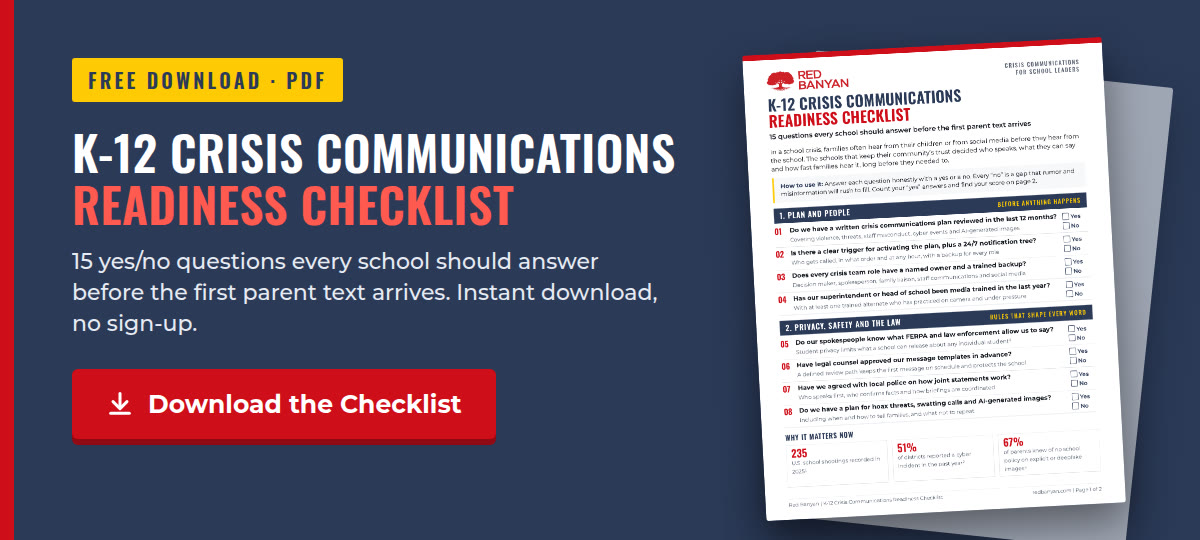
How ready is your school? Score it with our 15-question K-12 Crisis Communications Readiness Checklist.
When Should a School Bring In Crisis PR Counsel?
The best time is before anything happens. A crisis firm can audit an existing plan, write the templates, train the spokesperson, and run a tabletop exercise while the stakes are low. The second best time is the moment a crisis begins, when an outside team brings judgment and capacity that an overloaded communications office cannot.
Most districts and private schools have one or two communications professionals, and in a serious crisis they will be fielding hundreds of family inquiries, dozens of reporters, and a board that wants answers by the hour. An experienced partner can draft, coordinate, and handle the media so school leaders can focus on students.
Red Banyan works with school districts, private and independent schools, colleges, and education companies through our education crisis communications and PR practice. Our crisis prevention and planning team builds plans before they are needed, our media training prepares superintendents and heads of school to speak under pressure, and our crisis response management team becomes an extension of your leadership when a crisis is already underway. For more tools across every sector, visit the Red Banyan Crisis Management Resource Center.
Free Download: K-12 Crisis Communications Readiness Checklist
Use these questions to assess your school’s current readiness. If you cannot answer yes to each one, your school has a gap worth closing.
- Do we have a written crisis communications plan reviewed in the last 12 months?
- Can we send a holding message to every family within 30 minutes, at any hour?
- Has our superintendent or head of school been media trained in the last year?
- Do our spokespeople know what FERPA and law enforcement allow us to say?
- Do we have pre-approved message templates for our top five scenarios?
- Do staff hear from leadership before families and the media do?
- Do we have one update page ready to go live in minutes?
- Have we run a tabletop drill with a simulated media response in the last year?
- Do we have crisis communications counsel on call, with an agreement in place?
For a fuller assessment, download our free two-page K-12 Crisis Communications Readiness Checklist. It turns this guide into 15 yes/no questions across four areas: plan and people; privacy, safety and the law; the first hour; and staff, families and practice. Count your “yes” answers to see whether your school is Ready, Exposed or At Risk. It is a direct download with no form to fill out.
Want a second set of eyes? Contact Red Banyan to request a school crisis communications readiness review.
Is Your School Ready?
No school leader wants to imagine the worst day of the school year. Yet the schools that keep their families’ trust through a crisis are almost always the ones that planned for it, practiced it, and decided in advance who would speak and what they would say.
At Red Banyan®, we help superintendents, heads of school, boards, and communications teams prepare for the moments that matter most. Whether you are building a plan from scratch, updating one after a near miss, or facing a crisis right now, our team will help you protect your students, your staff, and the trust your community places in you.
Do not wait for the first parent text. Contact Red Banyan’s crisis communications experts today.
Read Next: Higher Education Crisis Communications: A Guide for College and University Leaders