Higher education crisis communications is the planned, practiced way a college or university informs students, parents, faculty, staff, trustees, donors, alumni, government officials, and the media before, during, and after an emergency or a threat to its reputation. It decides who speaks for the institution, who approves each message, what the law allows it to say, and how quickly each audience hears it.
A university can have a tested emergency plan, a capable police department, and a deep bench of lawyers and still lose a crisis in its first afternoon. The campus alert goes out, and within minutes the student newspaper, a parent Facebook group, a beat reporter, a state legislator, and a major donor are all asking the president’s office the same question. The institutions that come through those days with their trust intact are the ones that settled, well in advance, who would answer and what they would say.
Key takeaways
- Speed decides most campus crises, and universities lose them by moving at the pace of committees while the story moves in hours
- Federal law shapes the first message: the Clery Act requires emergency notifications without delay, while FERPA and Title IX limit what can be said about individual students
- A university statement now reaches every audience at once, including students, faculty, donors, alumni, lawmakers, and federal agencies, so it has to hold up in front of all of them
- Internal reviews protect the process and rarely satisfy the public on their own, so they should be paired with interim action and a schedule of updates
- Athletics, hazing, protests, and federal scrutiny now generate as many campus crises as safety incidents, and each one needs its own prepared response
- A crisis communications partner on call lets a college move within the hour, because the plan, the statements, and the approvals already exist
In This Guide
- What Is Higher Education Crisis Communications?
- Why Campus Crises Outrun University Decision-Making
- What Crises Do Colleges and Universities Face?
- What Laws Shape What a University Can Say in a Crisis?
- Who Needs to Hear From the University First?
- Case Studies: What Recent University Crises Teach Us
- What Should a University Say in the First Hours?
- The First 72 Hours: A University Crisis Communications Timeline
- How Should Colleges Communicate About Protests and Federal Scrutiny?
- How Should a College Handle a Crisis in Athletics?
- What Should a College Crisis Communications Plan Include?
- When Should a University Bring In Crisis PR Counsel?
- Free Download: Higher Education Crisis Readiness Scorecard (PDF)
- Is Your Institution Ready?
- Frequently Asked Questions
Last updated November 2026
What Is Higher Education Crisis Communications?
Higher education crisis communications, also called university crisis communications or crisis management for colleges, is the part of institutional crisis planning that governs words: what the college tells each audience, through which channels, in what order, and on what schedule. Safety always comes first. Communication determines whether the campus community and the public believe the institution’s account once everyone is safe.
It sits next to two related disciplines. Emergency management covers the physical response, such as lockdowns, evacuations, and reunification. University reputation management covers the long game of how an institution is perceived over years. Crisis communications connects them in the hours and days when a single event can undo a decade of goodwill.
When The New York Times examined how universities respond under national scrutiny in October 2026, I told the reporters that moving too slowly is how colleges tend to botch their responses. “We live in a rapid-fire world where reputations are made and destroyed in moments, not months.” Every recommendation in this guide follows from that reality.
Why Campus Crises Outrun University Decision-Making
Universities are designed for deliberation. Decisions move through deans, provosts, general counsel, faculty senates, and boards of trustees, and that process serves teaching and research well. A crisis runs on a different clock. Students post video before the first police unit arrives, the student newspaper publishes overnight, and national outlets pick up the story by the next morning.
The audiences are also larger and more demanding than they were a decade ago:
- Public trust is thin. In Gallup’s June 2026 survey, 38% of U.S. adults said they had a great deal or quite a lot of confidence in higher education, down from 42% in 2025 and well below the 57% Gallup recorded in 2015. A college in crisis starts with less benefit of the doubt than it once enjoyed
- Federal scrutiny is direct. Since 2025, federal agencies have frozen or withheld billions of dollars in grants and contracts from several universities, and a series of institutions reached settlements to restore that funding. A campus controversy can now carry an immediate financial cost
- Cyber incidents are routine. In Sophos’s State of Ransomware in Education 2025 report, data was encrypted in 58% of the ransomware attacks on higher education institutions surveyed, and one in three of those institutions also had data stolen
- Hazing is now public data. Under the federal Stop Campus Hazing Act, colleges must publish a Campus Hazing Transparency Report and, beginning with the October 2026 annual security report, include hazing statistics alongside other campus crime data
Each of these crises has a legal, technical, or operational response. Each also has a communications response, and on most campuses it is the one that has been practiced least.
What Crises Do Colleges and Universities Face?
The list is long, and every institution should plan for the scenarios most likely to affect it. Grouping them by type helps a crisis team see which audiences, approvals, and rules each one involves.
Crisis type | Examples | Who needs to hear first | Rules that shape the message |
Campus safety | Active threats, shootings, assaults, swatting calls, fires, severe weather | Students and employees on campus | Clery Act emergency notifications and timely warnings |
Student welfare | A student death, suicide, overdose, hazing injury, or missing student | The family, then roommates, teammates, and close friends | FERPA, family wishes, the Stop Campus Hazing Act |
Sexual misconduct | Allegations against students, faculty, coaches, or administrators | Complainants and the campus community | Title IX procedures, FERPA, confidentiality of investigations |
Protest and speech | Encampments, disrupted events, controversial speakers, arrests | Students, faculty, and campus police | Campus speech policies, the First Amendment at public institutions |
Federal and political scrutiny | Funding freezes, civil rights investigations, congressional hearings | Trustees, faculty, researchers, and donors | Federal grant terms, agency investigation procedures |
Athletics | Hazing, coach misconduct, player injuries, recruiting or eligibility violations | Athletes and their families | NCAA and conference rules, FERPA, employment law |
Data and technology | Ransomware, data breaches, AI-generated images, system outages | Affected students and employees | State breach notification laws, FERPA |
Leadership and governance | Presidential misconduct, board conflict, budget cuts, program closures, layoffs | Faculty, staff, and trustees | Employment law, open records laws at public universities |
Academic integrity | Research misconduct, admissions fraud, accreditation problems | Faculty, current students, and applicants | Accreditor and funding agency rules |
Two of these categories deserve their own attention. Protests and federal scrutiny are covered below and in our analysis of crisis response strategies for colleges facing protests and federal funding threats. Athletics has its own section later in this guide.
What Laws Shape What a University Can Say in a Crisis?
Federal law sets both the floor and the ceiling for a university’s first message. The Clery Act requires colleges to warn the campus quickly about serious threats, while FERPA and Title IX restrict what they can disclose about individual students. A college that knows these rules in advance can communicate quickly and still protect privacy.
Law or rule | What it requires or limits | What it means for communications |
Clery Act | Emergency notifications without delay once a significant emergency is confirmed, and timely warnings about Clery crimes that pose a serious or continuing threat | The first alert cannot wait for the full story. Templates and the authority to send them must exist in advance |
FERPA | Generally protects personally identifiable information in student education records, with a health or safety emergency exception | Messages should center on safety, verified facts, and next steps. Names, grades, and discipline records stay out |
Title IX | Requires a structured grievance process for sex discrimination and harassment complaints. The Department of Education enforces the 2020 regulations after a federal court vacated the 2024 rule | The university can explain its process and its support for those involved, and generally cannot comment on the merits of a pending case |
Stop Campus Hazing Act | Requires hazing policies, public reporting of hazing violations, and hazing statistics in the annual security report | Hazing incidents will become public. Plan the explanation before the report is posted |
State open records laws | At public universities, emails, texts, and documents can be requested by reporters | Internal messages should be written as though they may one day be published |
Sources: Clery Act regulations, FERPA and its health or safety emergency exception, Title IX rule update, Stop Campus Hazing Act
I advise every university to have counsel review its crisis templates long before they are needed. The strongest responses come from legal and communications teams working side by side from the first hour, because a statement shaped only by legal risk tends to sound evasive to everyone outside the general counsel’s office.
Who Needs to Hear From the University First?
The people closest to the crisis should hear from the institution before they hear from the news. Students and employees on campus come first for any safety incident. Affected families come next, followed by the wider campus, trustees, and key partners, with the public statement released at the same moment or shortly after.
Audience | Why they matter in a crisis | Best channel | Usually delivered by |
Students and employees on campus | They are the people at risk, and they will post what they see | Emergency alert system, text, email | Campus police or emergency management |
Affected students and their families | They deserve the facts before strangers do | Phone call or in-person meeting | Dean of students or a senior leader |
Faculty and staff | They will field questions in every classroom and office | Email from the president or provost, followed by a briefing | President or provost |
Trustees | They carry fiduciary responsibility and will be called by reporters and donors | Direct call, then a written briefing | President and board chair |
Parents and families | They are the most anxious audience and the fastest to escalate on social media | Email and a single update page | Student affairs |
Donors and alumni | Their confidence affects giving and the long-term reputation of the institution | Personal outreach to major donors, then email | Advancement office |
Elected officials and agencies | They may be asked for comment or may already be involved | Direct call | Government relations office |
Athletics conferences and partners | They may share responsibility for the program or the response | Direct call | Athletic director |
News media | They will report the story whether or not the university speaks | Statement, update page, briefing | Trained spokesperson |
A university statement written for one of these audiences will be read by all of them. The safest message is one that is accurate, consistent with everything the institution has said before, and defensible in front of a student, a parent, a donor, and a congressional committee alike.
Case Studies: What Recent University Crises Teach Us
The December 2023 Congressional Hearing: When Legal Precision Sounds Like Evasion
On December 5, 2023, the presidents of Harvard, the University of Pennsylvania, and MIT testified before the House Education and the Workforce Committee about antisemitism on their campuses following the October 7 Hamas attack on Israel. Asked whether calling for the genocide of Jews would violate their codes of conduct, the presidents gave answers that depended on context.
Those answers may have been accurate statements of campus policy. To donors, alumni, students, and the national audience watching, they sounded evasive. Penn’s president resigned four days later, and Harvard’s president stepped down in early January 2024 after a separate controversy over her academic work deepened the pressure. Columbia’s president, who testified in April 2024, resigned that August after months of protests and criticism on her campus.
The lesson is that a hearing room, a press conference, and a viral clip all reward the same skill: a plain answer to the question actually asked, followed by the context. Leaders who will face hostile questioning need media training built for that setting, with counsel in the room, well before the date arrives.
Northwestern Football: When Someone Else Tells the Full Story
In July 2023, Northwestern University announced that an independent investigation had confirmed hazing in its football program and that head coach Pat Fitzgerald would be suspended for two weeks. The next day, the student newspaper, The Daily Northwestern, published a former player’s detailed account of the hazing. Three days after announcing the suspension, the university fired Fitzgerald, and its president wrote that he may have erred in weighing the appropriate sanction.
The reversal became a second story on top of the first. When a university announces a decision and then others reveal facts the public was never given, the original decision looks inadequate, whatever the reasoning behind it. Institutions should assume the full facts will come out, and should share as much of them as privacy and the law allow at the moment they announce what they are doing.
Federal Funding Under Pressure: When Every Audience Reads the Same Statement
In 2025, federal agencies froze or withheld research funding at several universities over civil rights findings and related concerns. Penn and Columbia reached agreements with the government that July, Columbia’s including more than $200 million in payments, and Brown, Cornell, Northwestern, and the University of Virginia later reached agreements of their own. Harvard challenged its freeze in court, and in September 2025 a federal judge ruled that more than $2 billion in grants had been frozen illegally, a decision the government appealed, according to NPR.
Whatever path an institution chooses, the communications task is the same. Researchers want to know whether their labs will stay open. Students want to know what changes on campus. Donors, alumni, and faculty want to understand the reasoning. Federal officials will read every word. A college should explain its decision once, clearly, to all of those audiences at the same time, and then keep its later statements consistent with it.
Arizona State: When the Process Becomes the Message
When hockey player Matthew Mayich collapsed during a workout at Arizona State University in August 2026, its athletic director described the university’s inquiry as a review and said it was not an investigation, and the public heard a conclusion reached before anyone had looked at the facts. Our analysis of what Arizona State’s response teaches about crisis communications explains why audiences judge an institution by how it searches for answers long before the answers arrive.
As I told The New York Times, internal reviews and committees are “almost always criticized for being inadequate, slow and unresponsive,” and while they run, schools are left “taking it on the chin day after day.” An investigation is necessary. It needs to be credible, independent where the stakes require it, and paired with interim action and a regular schedule of public updates.
How Red Banyan Helped a University Prepare Before the Questions Came
Some of the most effective crisis work happens before a story ever breaks. In one engagement, a higher education institution faced internal and external pressure from a sensitive legal situation tied to staff contract matters. Leadership was bracing for questions it had no agreed answers to, with the risk that different administrators would tell faculty, the campus, and reporters different things.
Red Banyan developed messaging and holding responses, shaped consistent communication for internal and external audiences, and prepared leadership for a range of possible developments. The institution went into that period with statements drafted and a shared understanding of who would say what, so that a single unplanned comment could not become the story.
What Should a University Say in the First Hours?
In the first hours, a university should confirm that it is aware of the situation, state what it is doing to protect students and employees, tell the campus where updates will be posted, and say when the next update will come. It should share only verified facts, express genuine concern for anyone affected, and protect the privacy of every student involved.
I advise university leaders to release a first statement within the first hour of a serious incident becoming public, even when it contains very little. A short, human statement issued quickly does far more good than a polished one issued days later, because students and reporters will fill any silence with whatever is circulating online. For a safety emergency, the Clery Act alert should go out even sooner, often within minutes.
A useful first statement answers four questions. What do we know right now? What are we doing about it? How are we supporting the people affected? When will we say more? Everything beyond those answers can wait for verification.
The First 72 Hours: A University Crisis Communications Timeline
The first three days set the tone for everything that follows. Red Banyan’s 24-hour crisis messaging playbook covers the general framework. For a college or university, the timeline typically looks like this:
Time window | Priority | Communications actions |
First 15 minutes | Warn | Issue a Clery emergency notification if there is an immediate threat, and convene the crisis team |
First hour | Acknowledge | Confirm facts with campus police, notify the president and board chair, release a short holding statement, open one update page |
Hours 1 to 6 | Inform the campus | Send messages from the president or provost to students, faculty, staff, and parents, brief trustees, call major donors and elected officials |
Hours 6 to 24 | Brief the media | Hold one coordinated briefing with a trained spokesperson, monitor student media and social channels, correct false information with verified facts |
Day 2 | Show action | Announce interim steps, counseling and academic support, and any independent review, with a schedule for updates |
Day 3 | Steady the institution | Hold a campus forum or town hall, update faculty and staff, give trustees and donors a fuller briefing, and follow through on every commitment made so far |
How Should Colleges Communicate About Protests and Federal Scrutiny?
Colleges should set and publish clear rules for protest, enforce them consistently, and explain each decision in plain terms to every audience at once. The institutions that keep their credibility are the ones whose actions match their stated policies, whatever the cause and whoever is protesting.
Consistency matters more than any single statement. A university that enforces its rules against one group and not another will be accused of bias by both. Before the next semester begins, leaders should be able to explain what counts as lawful protest on their campus, what counts as disruption, who decides, and what happens next.
Federal scrutiny follows the same principle. When an agency opens an investigation or questions a grant, the university should acknowledge it, explain how it is responding, and avoid statements that will need to be walked back once negotiations or litigation begin. Faculty and students should hear the institution’s position directly, before it appears in the news.
For a deeper look at preparation, read our guide to crisis response strategies for colleges facing protests and federal funding threats and our article on how to handle a social media backlash.
How Should a College Handle a Crisis in Athletics?
A college should treat an athletics crisis as an institutional crisis from the first hour, with the president’s office, the athletic department, and counsel speaking with one voice. Athletes and their families should hear from the university first, and every public statement should make clear who is responsible for the response.
Athletics programs live under a microscope. Games are filmed from the stands, players and recruits have large social media followings, and sports reporters cover the program every day. A minor incident can grow into a national story within a weekend, and the coach often becomes the face of the crisis whether or not the university intends it.
Several practices help:
- Decide who speaks. The athletic director and head coach should not issue statements that the president’s office has not approved
- Separate the investigation from the program. When coaches or staff are part of the question, the people running the review should be independent of them
- Tell the full story at the start. As the Northwestern case shows, announcing a sanction without the findings behind it invites others to fill in the details
- Prepare for hazing disclosures. With the Stop Campus Hazing Act now requiring public reporting, every program should have a plan for explaining past violations and the changes made since
Hazing and misconduct can reach younger athletes as well. Our guide to youth sports crisis communications for schools and leagues covers that side of the issue.
What Should a College Crisis Communications Plan Include?
A complete plan sits alongside the institution’s emergency operations plan and is reviewed at least once a year. At a minimum, it should include:
- A vulnerability audit of the crises most likely to affect your institution, ranked by likelihood and impact
- A small crisis team with clear decision authority, including who can approve a public statement within the hour
- Clery Act alert templates and the authority to send them at any hour
- Pre-approved holding statements for your top scenarios, reviewed by counsel
- An audience map that sets the order in which students, families, faculty, trustees, donors, officials, and the media hear from you
- Trained spokespeople, including the president, the provost, and at least one alternate
- A single update page that can go live within minutes
- Monitoring of news, student media, social platforms, and online forums
- A tabletop exercise each year that includes a simulated media response and a hostile interview
Our guide to university reputation management explains how to build the proactive side of that plan, and our article on how to leverage PR and storytelling for college admissions covers how to build the goodwill a college will draw on when something goes wrong. If a data breach or AI-generated image is on your list of risks, read the steps to take after a data breach and our guide to deepfakes and crisis communications.
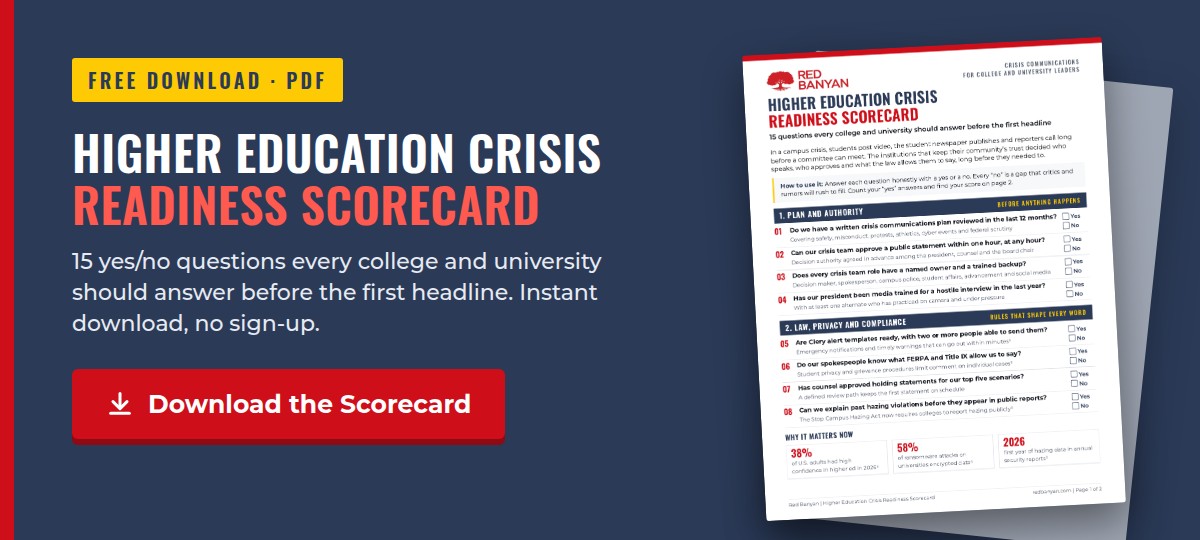
FREE DOWNLOAD
How ready is your institution? Score it with our 15-question Higher Education Crisis Readiness Scorecard.
When Should a University Bring In Crisis PR Counsel?
The best time is before anything happens. A crisis firm can audit an existing plan, write templates, train the president and other spokespeople, and run a tabletop exercise while the stakes are low. The second best time is the moment a crisis begins, when an outside team brings judgment and capacity that an overloaded communications office cannot.
University communications teams are often large, and most of their work is marketing, admissions, and media relations for research and athletics. In a serious crisis they will be fielding calls from reporters, parents, trustees, and lawmakers at the same moment, while leadership is pulled into meetings with counsel and police. An experienced outside partner can draft, coordinate, and handle the press so that leaders can focus on the people affected.
Red Banyan works with colleges, universities, K-12 schools, and education companies through our education crisis communications and PR practice. Our crisis prevention and planning team builds plans before they are needed, our media training prepares presidents and senior leaders to speak under pressure, and our crisis response management team becomes an extension of your leadership when a crisis is already underway. For more tools across every sector, visit the Red Banyan Crisis Management Resource Center.
Free Download: Higher Education Crisis Readiness Scorecard
Use these questions to assess your institution’s current readiness. If you cannot answer yes to each one, your college or university has a gap worth closing.
- Can our crisis team approve and release a public statement within one hour, at any hour?
- Do we have Clery Act alert templates ready, and does more than one person have the authority to send them?
- Has our president been media trained for a hostile interview or hearing in the last year?
- Do our spokespeople know what FERPA, Title IX, and the Clery Act allow us to say?
- Do we have pre-approved holding statements for our top five scenarios?
- Do faculty, staff, and trustees hear from leadership before the media reports the story?
- Do we have a plan for explaining hazing violations before they appear in our public reports?
- Have we run a tabletop exercise with a simulated media response in the last year?
- Do we have crisis communications counsel on call, with an agreement in place?
For a fuller assessment, download our free two-page Higher Education Crisis Readiness Scorecard. It turns this guide into 15 yes/no questions across four areas: plan and authority; law, privacy and compliance; the first hours; and audiences and practice. Count your “yes” answers to see whether your institution is Ready, Exposed or At Risk. It is a direct download with no form to fill out.
Want a second set of eyes? Contact Red Banyan to request a higher education crisis readiness review.
Is Your Institution Ready?
No president or board chair wants to imagine the day their campus leads the national news. Yet the colleges that keep the trust of their students, faculty, and donors through a crisis are almost always the ones that planned for it, practiced it, and decided in advance who would speak and what they would say.
At Red Banyan®, we help presidents, trustees, general counsel, and communications teams prepare for the moments that matter most. Whether you are building a plan from scratch, updating one after a near miss, or facing a crisis right now, our team will help you protect your students, your people, and the reputation your institution spent generations building.
Do not wait for the first headline. Contact Red Banyan’s crisis communications experts today.
Read Next: School Crisis Communications: A Guide for K-12 and Private School Leaders