
In This Guide
- Key Takeaways
- The Riddle
- Why Data Centers Are Suddenly Everywhere
- The Backlash by the Numbers
- What Communities Are Actually Worried About
- The Industry’s Diagnosis Is Incomplete
- Why the Backlash Behaves Like a Cancellation Campaign
- Why Traditional Crisis PR Falls Short Here
- The Red Banyan Playbook
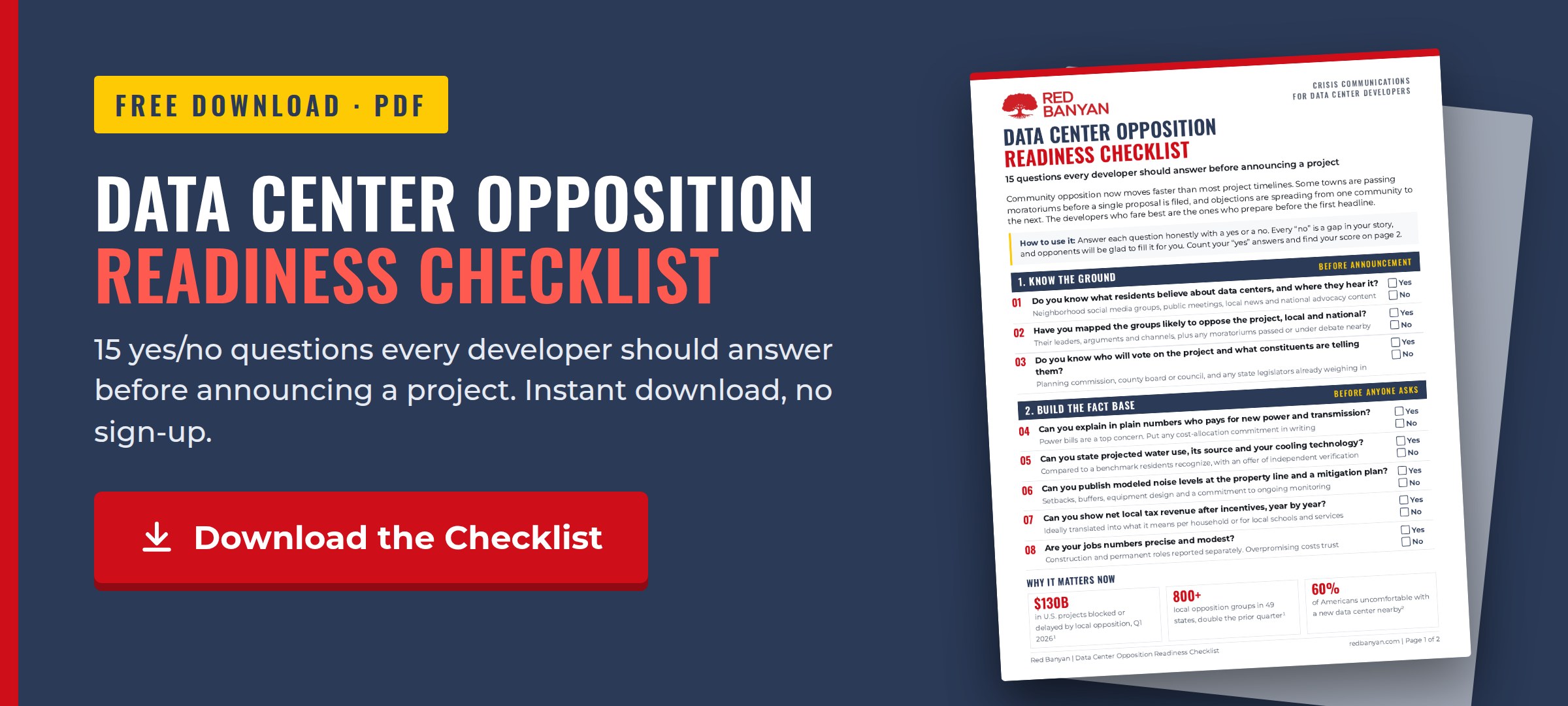
- Free Download: Data Center Opposition Readiness Checklist (PDF)
- What Support Looks Like Where Data Centers Already Operate
- Why Red Banyan
- Frequently Asked Questions
- Sources
Last updated October 2026
Key Takeaways
- The backlash is at record scale. At least 75 U.S. data center projects worth about $130 billion were blocked or delayed by community opposition in the first quarter of 2026, roughly matching all of 2025 in three months (Data Center Watch)
- Opposition often arrives before the project does. Towns with no data center proposals on the table are passing moratoriums anyway, a sign that the debate is being driven by a national story
- The standard playbook has not kept pace. Early engagement, transparency and better community benefits still matter. On their own, they have not stopped the losses from mounting
- The pattern looks like cancel culture. Pressure that spreads faster than facts, talking points that travel from town to town, and goalposts that move after every concession are hallmarks of a cancellation campaign
- Developers need cancel culture defense on top of community relations. That means preparing the narrative before announcement, building credible local validators, and answering misinformation quickly with verifiable facts
The Riddle
Here is a riddle from the American economy in 2026.
The county with the largest concentration of data centers on Earth spent a decade cutting its homeowners’ property tax rate. Loudoun County, Virginia, home to more than 230 data center buildings by its own count, lowered its real estate tax rate from $1.145 per $100 of assessed value in 2016 to $0.805 in 2026. Data centers now generate roughly 38 percent of the county’s general fund revenue while occupying about 4 percent of its commercial land.
Meanwhile, hundreds of miles away, towns that have never seen a data center are passing moratoriums against projects that do not exist. Lochbuie, Colorado, approved a five-year moratorium this summer even though, according to its mayor, no developer had ever approached the town. A township outside Charlevoix, Michigan, passed a 180-day pause before fielding a single proposal.
Nationwide, community opposition blocked or delayed at least $130 billion worth of data center projects in the first three months of 2026. That matches the scale of all of 2025, in a single quarter.
Notice the pattern. Outrage that arrives before the project does is not growing from what residents have lived through. It is growing from a story.
And that story is now strong enough to reach even the places with the longest track record. In September, Loudoun’s own Board of Supervisors voted to begin drafting a pause of up to 12 months on new data center applications. When the narrative can move the one county with the clearest record of fiscal benefits, no community is out of range, and no developer can assume its project is safe.
Why Data Centers Are Suddenly Everywhere
The boom is real, and it is fast. Artificial intelligence requires enormous computing power, and computing power requires buildings, electricity and water. The four largest U.S. cloud providers signaled plans to spend roughly $700 billion or more on capital expenditures in 2026, much of it on data center capacity, up from about $410 billion in 2025, according to tallies of their first-quarter earnings guidance.
That spending has to land somewhere. As traditional hubs run short of available power and land, developers are moving into suburban, exurban and rural communities that have never hosted this kind of infrastructure.
Table 1: The data center boom at a glance
Indicator | Figure | Source |
Planned 2026 capital spending, four largest U.S. cloud providers | Roughly $700B+ (vs. about $410B in 2025) | Company Q1 2026 earnings guidance, as tallied by financial press |
Loudoun County, VA electricity demand from data centers | 5.33 GW in 2025, nearly a quarter of Dominion Energy's Virginia load | Loudoun County / Dominion Energy |
Share of new power demand PJM expects from data centers this decade | More than 90% | PJM Interconnection |
Loudoun data center buildings, built or under construction | About 233 (March 2026) | Loudoun County |
Scale changes the conversation. Today’s data centers are gigawatt-class industrial projects, and residents are asking hard questions about what they mean for their bills, their water and their neighborhoods.
The Backlash by the Numbers
The opposition has grown from scattered local disputes into a national movement in less than two years.
Table 2: Data center opposition, 2026
Metric | Figure | Source | Date |
Projects blocked or delayed by opposition, Q1 2026 | At least 75 projects, about $130B | Data Center Watch | Q1 2026 |
Projects blocked or delayed, Q2 2026 | About 45 projects, about $68B | Bloomberg, citing Data Center Watch data | Q2 2026 |
Active local opposition groups | More than doubled in one quarter, to more than 800 across 49 states | Data Center Watch | End of Q1 2026 |
State data center bills filed | More than 300 in the first six weeks of the year | Data Center Watch; state policy trackers | Jan to Feb 2026 |
Coordinated protests in a single day | 142 protests across 42 states | Reuters | July 18, 2026 |
Americans uncomfortable with a new data center in their area | 60% | Pew Research Center | Jul to Aug 2026 |
Americans who say data centers are mostly bad for home energy costs | 50%, up from 38% in January | Pew Research Center | Aug 2026 |
The pace of project losses eased somewhat in the second quarter, while public sentiment kept getting worse. Between January and August 2026, the share of Americans who said data centers are mostly bad for quality of life in nearby communities rose from 30 percent to 49 percent, according to Pew. The concern crosses party lines: majorities of both Republicans and Democrats say they would be uncomfortable with a new facility nearby.
What Communities Are Actually Worried About
Any honest guide to this issue has to start here: many of the concerns are legitimate. Residents are right to ask who pays for new transmission lines, how much water a facility will draw, and what a 24-hour industrial operation will sound like from their back porch. Red Banyan has advised homeowners who opposed data center construction, and we have seen firsthand how real those worries are.
Developers who answer these questions with specifics earn the right to be heard.
Table 3: Common community concerns and how to address them
Concern | What opponents say | What developers should be ready to show | How to communicate it |
Electricity bills | Households will subsidize the grid upgrades data centers need | Who pays for new generation and transmission; any large-load tariff or cost-allocation commitment | Put the commitment in writing and in plain numbers. Let the utility or regulator confirm it |
Water | The facility will drain local supply during droughts | Cooling technology, projected annual use, water source, recycling plans | Compare use to familiar local benchmarks. Offer independent verification |
Noise | Constant hum from cooling systems and generators | Modeled sound levels at the property line, setbacks, mitigation design | Invite neighbors to hear an operating facility. Publish monitoring data |
Land use and character | Farmland and open space will become an industrial zone | Site plan, buffers, design standards, footprint versus surrounding uses | Show renderings from the neighbors' vantage point |
Tax breaks | The community gives away revenue to a giant corporation | Net local tax revenue after incentives, year by year | Lead with what residents gain, in dollars per household where possible |
Jobs | Data centers employ almost no one after construction | Construction jobs, permanent roles, local hiring commitments | Be precise and modest. Overpromising on jobs is the fastest way to lose trust |
In some places a concern is well founded, and the right answer is a better project or a different site. Accountability is not the same as cancellation. The challenge for developers is that, increasingly, they face both at once.
The Industry’s Diagnosis Is Incomplete
Ask the industry what is happening and you will hear the same answer everywhere: a community relations problem. Engage earlier. Be more transparent. Sweeten the benefits package.
That answer is not wrong. It is incomplete.
These are real community relations problems, but they are compounding at a speed and scale that community relations alone cannot explain. Developers have spent two years following the standard advice, and the losses kept mounting anyway. In the first quarter of 2026, opposition stalled as much investment as it did in all of the prior year.
When the treatment is being applied and the patient keeps getting worse, something else is at work.
Why the Backlash Behaves Like a Cancellation Campaign
Start with a definition. Cancel culture is the effort to withdraw support from a person or organization, and to pressure others to do the same, over something considered objectionable. In my book, The Cancel Culture Curse, and in years of advising clients under fire, I have seen that cancellation campaigns are rarely about a single fact. As I have written, activism in the form of cancel culture “relies on sustained and overwhelming pressure designed to produce a desired outcome.”
That is a useful lens for what developers are facing now. To be clear, the point here is about dynamics. Residents with real concerns are acting in good faith, and there is no evidence that the opposition as a whole is centrally directed. The dynamics of data center opposition increasingly resemble those of a cancellation, and those dynamics call for a different response.
Here are the telltale signs.
- Opposition forms before there is anything to oppose. Moratoriums are passing in towns where no project has been filed. The reaction is to the category itself
- The talking points travel. The same arguments now surface from community to community, often in nearly identical form. On July 18, 2026, a single national organization coordinated 142 protests in 42 states on the same day
- Facts arrive too late to matter. By the time a developer releases its water study or its tax projections, residents have already formed a view from social media and neighborhood groups
- Concessions move the goalposts. A larger buffer can become a demand for a different site. A community benefits agreement can be recast as a bribe. Each accommodation risks being treated as proof that the critics were right
- The target is the license to operate. The goal becomes stopping the project entirely
Table 4: A traditional corporate crisis versus a cancellation campaign
Dimension | Traditional corporate crisis | Cancellation campaign |
Trigger | A specific incident: an accident, a lawsuit, a bad decision | An identity or category: the type of business itself |
Who is upset | People directly affected | People directly affected, plus a larger audience that may never be affected |
Role of facts | Facts and corrective action usually settle the issue | Facts matter, but rarely settle the issue on their own |
Effect of concessions | Concessions resolve grievances | Concessions are often read as admissions and invite new demands |
How it spreads | News coverage, then fades | Social media and networked groups, then spreads to new locations |
Endgame | Restored trust | Withdrawal of support, rejection or exit |
Why Traditional Crisis PR Falls Short Here
Most crisis communications is built for the left column of that table. A defined incident, a defined audience, a response that resolves the grievance. Applied to a cancellation dynamic, the usual tools can backfire.
- Concessions read as admissions. Offered too late or without a clear story, they can confirm the opposition’s narrative
- Town halls become stages. An open microphone at a contentious meeting gives organized opponents a platform and a video clip
- Paid advertising looks defensive. A glossy campaign launched under fire signals that the developer is on the back foot
- Silence hands over the narrative. Waiting for the permit hearing to make the case means someone else has already made it
These tools still have a place. They need to be sequenced inside a broader strategy built for this kind of pressure.
The Red Banyan Playbook: Treat It as Cancel Culture Defense
Red Banyan’s approach to cancel culture is anchored in a simple principle we call Press the Truth®: identify the facts that are on your side, then communicate them early, clearly and persistently through voices people trust. Our Cancel Culture Response Playbook lays out the full ten-step framework. Here is how it applies to a data center project.
Phase 1: Before announcement
- Narrative audit. Map what residents in the target community already believe about data centers, and where they heard it
- Opposition mapping. Identify local and national groups likely to engage, their arguments and their channels
- Fact base. Build verified, plain-language answers on power, water, noise, taxes and jobs before anyone asks
- Local validators. Identify credible residents, business owners, educators and officials who can speak from their own experience
Phase 2: At announcement
- Own the first story. Announce with specifics, and put the community benefit in the first paragraph
- Lead with the tradeoffs. Acknowledge the real concerns up front. Credibility earned early is the hardest asset for opponents to take away
- Open a verified information hub. One place where residents and reporters can check facts, updated as the project evolves
Phase 3: Under attack
- Monitor before you respond. Separate online noise from genuine stakeholder concern
- Correct misinformation fast, with evidence. Answer specific false claims with specific facts, and never attack residents
- Put third-party voices forward. Utilities, local leaders and residents of existing host communities are often the most persuasive messengers
Phase 4: At the hearing and the vote
- Prepare spokespeople like it is a television interview. Every public meeting is now a media event
- Organize supporters to show up. Elected officials need to see that support is real and local
Phase 5: After approval
- Keep the promises visible. Report on commitments publicly and on schedule. Following through is what turns a contested project into a proof point for the next one
Free Download: Data Center Opposition Readiness Checklist
How prepared is your project for organized opposition? Our free two-page checklist turns this playbook into 15 yes/no questions to answer before you announce. Count your “yes” answers to see whether your project is Ready, Exposed or At Risk. It is a direct download with no form to fill out.
What Support Looks Like Where Data Centers Already Operate
The strongest argument for a data center is often a community that already has one. Loudoun County’s record is a real story: years of revenue that helped fund schools and public safety, and a property tax rate that fell by roughly 30 percent over ten years.
Loudoun also shows the limits of letting the numbers speak for themselves. Residents there have raised real concerns about noise, transmission lines and the pace of growth, and the county’s current debate over a pause shows that even a strong fiscal record does not sell itself. The benefits have to be explained, in human terms, by people the community trusts, and the concerns have to be answered directly.
That is the lesson for developers entering a new market: the case for a project has to be made early, in plain language, by voices the community trusts.
Why Red Banyan
Red Banyan is an international crisis management and strategic communications firm, and cancel culture defense is one of our core specialties. Over the years we have guided companies and individuals through online pressure campaigns, many of them sparked by issues that were trivial at the outset and became existential because no one got ahead of the story.
On data centers specifically, we know the issue from both sides of the table. Red Banyan has worked with utility companies involved in data center projects, and we have advised homeowners who opposed data center construction in their communities. That experience gives us an unusually clear view of what moves residents and what moves officials.
I wrote The Cancel Culture Curse to break down how these pressure campaigns start, spread and end, and how the people and organizations targeted by them can fight back. The same principles apply when the target is a data center project.
FREE DOWNLOAD
Is your project ready for organized opposition? Score it with our 15-question Data Center Opposition Readiness Checklist.
Facing opposition to a data center project? Talk to us before the first hearing. Contact Red Banyan for a confidential consultation.
Sources
- Data Center Watch, Q1 2026 report
- Bloomberg, “New Data Centers Worth $68 Billion Disrupted in US, Data Show,” Sept. 21, 2026
- Reuters, via U.S. News & World Report, “Data Center Opponents Stage 142 Protests Across 42 US States,” July 18, 2026
- Pew Research Center, “Americans’ views of data centers have turned more negative,” Sept. 22, 2026
- Loudoun County, “Data Centers: Tax Revenues & County Budget” and “Data Centers: The Loudoun Story,” loudoun.gov
- Loudoun County, Board of Supervisors action on data center and substation applications, Sept. 15, 2026
- Data Center Dynamics, “Town of Lochbuie, Colorado passes five-year data center moratorium,” 2026
- Interlochen Public Radio, “Charlevoix-area township passes data center moratorium,” Feb. 10, 2026
- PJM Independent Market Monitor, capacity auction analyses, 2025 to 2026
- Evan Nierman, “Five Steps To Rapidly And Decisively Respond When Facing Cancel Culture,” Forbes, July 20, 2020
- Red Banyan, Cancel Culture Response Playbook
- Evan Nierman, The Cancel Culture Curse
This guide is updated quarterly. Last updated October 2026.