
The executive who tells me “I don’t really talk to the press” is often the one I worry about most.
Not because they are doing anything wrong. Because they are assuming they get to choose when the spotlight finds them. After years of guiding leaders through reputational crises, I can tell you they almost never do.
Why executives who avoid the press need media training most
Executives who rarely speak to reporters need media training most because they have the least practice at the moment it matters. When a crisis hits, they are expected to sound calm, credible and prepared on the first try, with no warm-up and very little room for error.
Leaders who give interviews every week build instincts over time. They learn what a pointed question feels like, how long a pause really lasts and how a single phrase can become the headline. The executive who has not spoken to a reporter in years has none of that muscle memory.
Many assume their communications team will handle it, or that a written statement will be enough. Sometimes it is. But when the story is serious, reporters, employees, investors and customers usually want to hear from the person in charge. Silence from the top reads as indifference at best and guilt at worst.
A crisis picks the timing, not you
No executive gets to schedule a crisis. A product recall, a lawsuit, a leaked internal memo or a customer’s video that spreads overnight can put a leader in front of a microphone within hours. Preparation has to happen before that moment, because there is no time to build it once the story breaks.
Picture the leader who has not given an interview in years. A story breaks on a Tuesday morning. By noon, there are calls from reporters and a camera crew outside the office, and the first question is the one they least want to answer. They have a few seconds to sound credible. Whatever they say will be clipped, shared and replayed long after the facts are sorted out.
That is why the first day of a crisis matters so much, as we lay out in our 24-hour crisis messaging playbook. The words a leader chooses in those first hours often shape the story for months.
Media training is really about communicating under pressure
Here is what most people miss: media training isn’t really about journalists. It is about communicating clearly when the stakes are high, the questions are hard and the clock is running. The interview is simply the most visible place where those skills are tested.
Think of a reporter’s question as a stress test. It is pointed, it is public and it cannot be taken back. Train for that, and you are ready for nearly any high-pressure conversation. It is the same reason every spokesperson needs media training, whether or not they expect to be quoted this year.
The four skills media training builds
Good media training builds four skills: knowing your core messages cold, answering hard questions without getting defensive, steering back to your point when a conversation drifts, and resisting the urge to fill an awkward silence. Each one is simple to describe and hard to do under pressure without practice.
1. Know your core messages cold
Before any high-stakes conversation, you should be able to state your two or three most important points in plain language, without notes. If you can’t, the conversation will decide your message for you.
2. Answer the hard question without getting defensive
Defensiveness reads as guilt, even when you have nothing to hide. Acknowledge the question, answer it honestly and move forward. A calm answer to a tough question builds more credibility than a perfect answer to an easy one.
3. Steer back to your point
Conversations drift, sometimes by accident and sometimes by design. Bridging is the skill of acknowledging where a question went and bringing it back to what matters. Done well, it sounds natural. Done poorly, it sounds evasive, which is exactly why it takes practice. It also helps to understand the media ground rules every spokesperson should know, like the difference between on the record and on background, before you ever sit down.
4. Resist the urge to fill the silence
Silence feels longer to the person being interviewed than to anyone else in the room. Some of the most damaging quotes come from people who kept talking after they had already made their point. Say what you came to say. Then stop.
Where these skills show up outside the newsroom
The same skills matter far beyond interviews. Leaders use them at the all-hands meeting after a round of layoffs, on the investor call that goes sideways, and at the town hall where an employee asks the question nobody rehearsed. Today, almost anything a leader says in a room can end up outside of it.
A phone recording, a screenshot of a video call or a forwarded email can turn an internal moment into a public one in minutes. Employees, investors and customers are all audiences now. Media training prepares leaders for every one of them.
And if a story does run with errors, knowing how to correct media inaccuracies without damaging the relationship is part of the same discipline.
How do you know if your leadership team is ready?
A leadership team is ready when each member can deliver the organization’s key messages under pressure, handle a hostile or unexpected question calmly, and knows who speaks for the company in a crisis. If any of those answers is uncertain, the time to fix it is now, before it is tested in public.
A few questions worth asking this week:
- Who is our designated spokesperson if a story breaks tonight?
- Could our CEO explain our position in 30 seconds, without notes?
- When did our leaders last practice answering a question they didn’t want to hear?
- What is the one question our leadership team is least prepared to answer?
If the answers make you uncomfortable, that is useful information. It is far better to discover a gap in a training room than on the evening news.
Prepare before the question comes
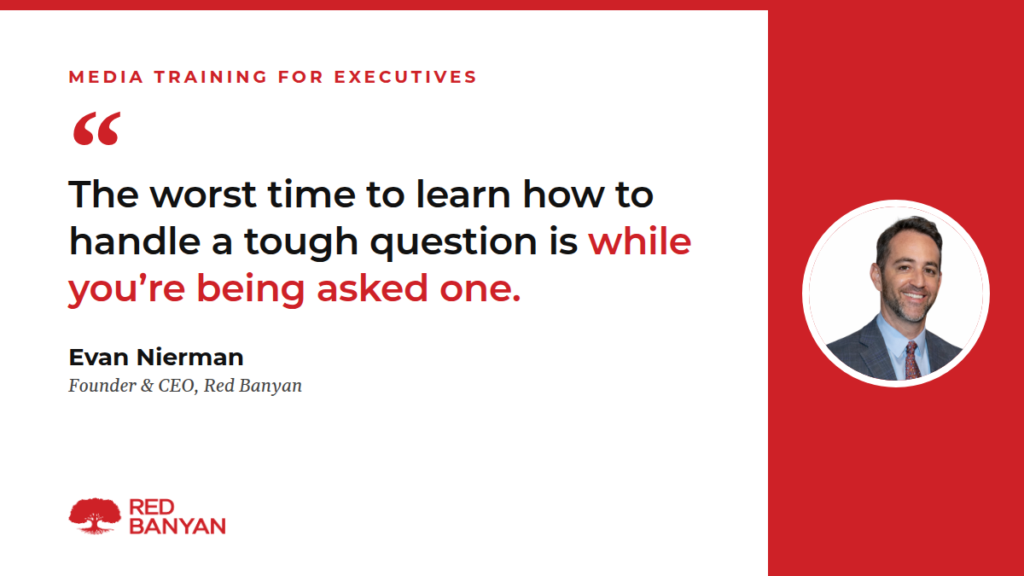
The best time to prepare is before you need it. Media training turns a moment of panic into a moment of composure, and composure is what audiences remember. The worst time to learn how to handle a tough question is while you’re being asked one.
Trust is built slowly and lost quickly. A single interview, meeting or clip can shape how people see a leader for years. Preparation is the cheapest insurance there is.
You don’t get to schedule your worst day. You only get to decide whether you’ll be ready for it.
If your leadership team has never been through media training, or it has been years since the last session, Red Banyan’s crisis management team can help you prepare before the spotlight finds you.
Media Training for Executives: Frequently Asked Questions
Yes. They often need it most. A crisis picks the timing, not the executive, and leaders who seldom speak to reporters have the least practice when a recall, lawsuit or viral video suddenly puts them in front of a microphone.
Media training teaches leaders to communicate clearly under pressure. The core skills are knowing your key messages cold, answering tough questions without getting defensive, steering back to your point when a conversation drifts and resisting the urge to fill an awkward silence.
No. The same skills matter at all-hands meetings, on investor calls and at employee town halls. Today almost anything a leader says in a room can be recorded or shared, so every audience is potentially a public one.
Before they need it. The worst time to learn how to handle a tough question is while you're being asked one. If your leaders have never been trained, or it has been years since the last session, now is the time.
Ask a few honest questions. Who is our spokesperson if a story breaks tonight? Could our CEO explain our position in 30 seconds without notes? When did our leaders last practice answering a question they didn't want to hear? Uncomfortable answers point to gaps worth closing.