
Last updated: November 2026
Much of the lasting damage from a data breach happens in the days after it is discovered. It comes from the company’s own data breach response: what it says, what it leaves unsaid and how long it waits to say anything at all.
The first call usually comes from IT. Unauthorized access. Customer records involved. Scope unknown. Within hours the questions arrive from every direction. Customers want to know whether they are exposed. Employees want to know what to tell people. The board wants to understand the liability. Reporters want a statement. How a company answers in that first stretch often decides whether a breach stays a contained incident or becomes the defining story about the business.
The stakes are measurable. IBM’s Cost of a Data Breach Report 2026 puts the global average cost of a breach at $4.99 million, a 12% increase over the prior year and a record high. Lost business is one of the drivers IBM names. That is the part of the bill that communications controls.
Here is what many executives miss: a data breach is a business crisis, and it requires a communications strategy from the first hour.
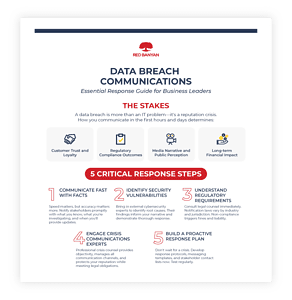
Download Red Banyan’s free one-page guide to data breach communications.

Quick Links:
- What Is Data Breach Response?
- Why Data Breach Communications Matter
- Data Breach Response Steps: A Communications Checklist
- Data Breach Notification Deadlines at a Glance
- The First 72 Hours: A Data Breach Communications Timeline
- Who to Notify and What to Tell Them
- Managing Social Media During a Data Breach
- Supporting Customers After a Data Breach
- Internal Communications During a Data Breach
- How to Build a Data Breach Response Plan
- After the Breach: Rebuilding Trust
- The Bottom Line
- Data Breach Response: Frequently Asked Questions
What Is Data Breach Response?
Data breach response is everything an organization does after discovering that sensitive data was exposed: containing the breach, investigating what happened, notifying the people and regulators the law requires, and communicating with every stakeholder who has reason to worry. The technical fix stops the damage. The communications response decides how much of your reputation survives it.
A complete response runs on two tracks at the same time. The technical track belongs to IT, outside forensics specialists and legal counsel. The communications track belongs to leadership and crisis communications counsel. The two tracks have to stay in lockstep. When they drift apart, companies make public promises that their own investigation cannot keep.
Why Data Breach Communications Matter
A breach creates several audiences at once, and each one has a different worry. Customers want to know whether their information is safe. Employees need clear direction on what to say and do. Board members want answers about liability and financial exposure. Regulators may arrive with compliance questions. Reporters may call for a statement before you have one.
Each of these groups needs communication built for it. A generic statement will not satisfy any of them. Silence carries its own risk. Information vacuums fill quickly, usually with speculation, rumor and worst-case scenarios that may bear little resemblance to the facts.
“No response is still a response, and it is rarely the one a company would choose.”
Evan Nierman, writing in Chambers and Partners
Every word also carries legal weight. As Evan noted in the same piece, “After a data breach, an organization’s own statements often become some of the most valuable evidence the other side has.” That is why communications and legal counsel need to work side by side from the first hour.
Your response becomes a referendum on your organization’s integrity. Are you transparent or evasive? Do you take responsibility or shift blame? Do you put the people affected ahead of your own legal exposure? Those judgments form quickly, and they last long after the technical problem is solved.
Data Breach Response Steps: A Communications Checklist
The Federal Trade Commission’s Data Breach Response: A Guide for Business lays out the operational steps: secure your systems, fix vulnerabilities and notify the appropriate parties. The four steps below cover the communications work that has to run alongside them.
Step 1: Confirm the Facts and Communicate Fast
Your first statement needs to be fast and accurate, because it sets the tone for everything that follows. Rush out incomplete or inaccurate information and you will spend weeks correcting the record. Wait too long and speculation fills the void.
Start with the facts you can state with confidence. What happened? When did it occur? What data may have been compromised? What have you already done about it? You will not have every answer on day one, and that is acceptable. What matters is being honest about what you know, what you are still investigating and when you will share an update.
Different stakeholders need different levels of detail. Customers want to know two things: Am I affected, and what should I do right now? Employees need operational guidance. Regulators need specific compliance information. Build each message for its audience instead of sending one statement to everyone.
Legal deadlines set the outer limit for notification. Organizations that communicate well before the deadline show they are taking the situation seriously and putting the people affected first.
Step 2: Contain the Breach and Find the Root Cause
You cannot credibly promise that a breach will not happen again until you know why it happened. Customers and regulators will want to hear that you found the root cause and closed the gap.
That often means bringing in outside cybersecurity experts. It is an added expense during an already costly crisis, but independent forensics specialists do two things your internal team cannot. They find vulnerabilities your own people may miss, and their involvement signals to stakeholders that you are taking a thorough, professional approach.
While the investigation runs, resist the urge to speculate publicly about the cause or scope. Early assessments often change as forensics work continues. A breach announced as small that later turns out to be large does far more damage than a careful first statement. Stick to what you know for certain, and commit to updates as you learn more.
Document everything. The findings will shape your remediation, your public account of what happened, your regulatory filings, your insurance claims and any litigation that follows.
Step 3: Meet Data Breach Notification Requirements
Data breach notification laws vary by jurisdiction and industry, and many organizations fall under several at once. Every U.S. state has its own breach notification law. Healthcare organizations answer to HIPAA. Public companies answer to the SEC. Companies that handle data on people in Europe answer to GDPR. The deadlines differ, and so do the details each notice must include. The deadline table below summarizes the main ones.
Getting this wrong has real consequences. Missing a required notice or deadline can bring fines and legal liability. And a notice that satisfies the letter of the law can still damage your reputation if it reads as evasive or confusing.
Work with legal counsel who understands both the regulatory requirements and the realities of crisis communications. The best lawyers weigh legal exposure alongside the relationships and reputation the company needs to protect.
Notification is also an opportunity to show responsibility. Organizations that go beyond the legal minimum, with clear guidance and real support for the people affected, tend to come out of a breach with their reputations more intact than those that take a purely legalistic approach.
One distinction shapes the whole notification question: the difference between a security incident and a data breach.
Cybersecurity incident | Data breach |
Any event that threatens the security of your systems, such as attempted hacking, malware or an exposed vulnerability | An incident in which unauthorized parties actually access, steal or expose sensitive data |
Usually does not trigger breach notification laws on its own (public companies may still owe the SEC disclosure if the incident is material) | Often triggers notice to affected individuals and regulators, depending on the data and the jurisdiction |
May still call for communication with employees, partners or customers if operations are affected | Requires a full communications response across every affected audience |
Step 4: Bring in Crisis Communications Counsel
Your internal team knows your business, but they are also deep in the crisis. Emotions run high. Pressure builds. Fatigue sets in. Clear-headed decisions about public communication get much harder when the same people are managing the technical response, fielding stakeholder questions and absorbing the stress of a major business crisis.
This is where experienced crisis communications professionals earn their place. They have seen many similar situations. They know the pitfalls that look obvious in hindsight but are easy to miss in the moment. And they can build a response that balances transparency, legal prudence and reputational protection.
A skilled crisis PR firm brings several capabilities to the table:
- Messaging that is clear, consistent and calibrated to each audience
- Anticipated questions and prepared answers, so leadership is not caught flat-footed
- Coordination across every channel, including press statements, the website, social media, customer notices and employee communications, so everyone hears the same core message
- An objective voice that can tell leadership hard truths
That last point may matter most. When the legal team wants to say nothing and the CEO wants to say everything, experienced crisis counsel can resolve that tension and find the path that serves the organization’s long-term interests.
Red Banyan has extensive experience guiding organizations through data breach crises, including healthcare data breaches, financial services incidents and breaches in other regulated industries. You can see an example of our work in this HIPAA data breach case study. For more on what this kind of support looks like, read Cybersecurity PR Firms: What They Are and Why You Might Need One.
Data Breach Notification Deadlines at a Glance
Deadlines depend on where the affected people live, what kind of data was exposed and what kind of organization you are. Here are the most common rules a U.S. business may face.
Rule | Who it covers | Deadline | Who must be notified |
State breach notification laws | Businesses holding personal information of a state's residents (all 50 states have one) | 20 states set a fixed deadline of 30 to 60 days. The rest require notice "without unreasonable delay" or similar wording | Affected residents, and often the state attorney general above set thresholds |
HIPAA Breach Notification Rule | Healthcare providers, health plans, clearinghouses and their business associates | Without unreasonable delay and no later than 60 days after discovery | Affected individuals, HHS, and prominent media when more than 500 residents of a state or jurisdiction are affected |
SEC Form 8-K, Item 1.05 | Public companies | 4 business days after determining an incident is material | Investors, through a public filing |
GDPR | Organizations handling personal data of people in the EU | 72 hours after becoming aware, where feasible | The supervisory authority, plus affected individuals without undue delay when the risk to them is high |
CIRCIA (pending) | Covered critical infrastructure entities | 72 hours for covered incidents and 24 hours for ransom payments, once the final rule takes effect | CISA |
This table is a general overview, not legal advice. State counts reflect the Privacy Rights Clearinghouse 2026 survey of state laws. Requirements change, and many organizations fall under several rules at once. Confirm your specific obligations with legal counsel.
The First 72 Hours: A Data Breach Communications Timeline
The first three days set the narrative. Here is how the communications work should unfold, alongside the technical response.
Timeframe | Communications priority | Owner |
Hour 0 to 1 | Activate the response team, engage legal and crisis communications counsel, and lock down who speaks for the company | CEO, general counsel |
Hours 1 to 24 | Confirm the known facts, draft a holding statement, prepare responses for customer service and social media, and brief employees before anything goes public | Communications lead, legal |
Hours 24 to 72 | Brief the board, prepare notification letters and regulatory filings, launch a dedicated update page, and line up a hotline if needed | Communications, legal, operations |
Weeks 1 to 2 | Send notifications, share investigation updates on a set schedule, track media and social conversation, and correct misinformation | Communications, customer service |
Day 30 and later | Report on findings and security improvements, continue support for affected people, and review what worked and what did not | Leadership, communications |
For a closer look at the first day of any crisis, see our 24-Hour Messaging Playbook.
Who to Notify and What to Tell Them
Each audience needs its own message, channel and timing. One statement copied to everyone will satisfy no one.
Audience | What they need to hear | Channel | Timing |
Affected customers | What happened, what data was involved, what you are doing and what they should do now | Notification letter or email, dedicated web page, hotline | As soon as the facts are confirmed, and within legal deadlines |
Employees | The facts, what to say if asked, and where to send questions | Internal briefing, talking points, intranet | Before any public announcement |
Board of directors | Scope, legal and financial exposure, response plan and next decisions | Direct briefing from the CEO and counsel | Within the first 24 to 72 hours |
Regulators | The specific information each rule requires | Formal filings led by counsel | By each rule's deadline |
Media | A clear, accurate statement and a named point of contact | Statement, website update, interviews when appropriate | When the breach is public or likely to become public |
Partners and vendors | Any impact on shared systems or data, and what changes now | Direct outreach from account owners | Early, especially if shared systems are involved |
Managing Social Media During a Data Breach
News of a breach can spread across social media within minutes. Customers take to X, LinkedIn and Facebook to voice concerns, ask questions and share their experiences. Employee speculation can leak out through personal accounts. Competitors may even add fuel to the fire.
Social media during a breach needs active management. Track mentions of your organization and the breach. Watch for misinformation that needs correcting. Identify legitimate customer concerns that need a direct answer.
Respond promptly and consistently. Your social team needs clear rules on what it can say and when to escalate to leadership. A line like “We take security seriously and are investigating” may be necessary in the first hours, but it wears thin fast. As the investigation progresses, share more substantive updates through official channels. Do not delete critical comments unless they violate platform rules. Deleting them looks like hiding.
Your website should be the single source of truth. Create a dedicated page with breach information, FAQs and regular updates, and point every other communication back to it. That gives reporters, customers and other stakeholders one reliable place to find accurate information instead of relying on secondhand accounts.
Supporting Customers After a Data Breach
Notification opens the customer conversation. What happens next decides whether you keep their business and their trust.
Give concrete, specific guidance. Should customers change passwords? Watch their financial statements? Be alert for phishing emails that use the breach as cover? Generic advice to “remain vigilant” leaves people with nothing to act on. Give them exact steps they can take today.
Consider offering tangible support:
- Credit monitoring when financial data is involved
- Identity theft protection or insurance
- A dedicated support line staffed by people who understand the situation and can answer questions
These steps show real concern for the people affected.
Keep customers informed as the situation evolves. When the investigation concludes, share the findings in appropriate detail. When you put new security measures in place, explain them. Ongoing communication shows that the company still takes the incident seriously.
Internal Communications During a Data Breach
Employees are both an audience and a channel. They need information to do their jobs during the crisis, and they shape outside perception through their own networks.
Brief your team early and often. No employee should learn about a breach from a news story or a customer call. Give them clear talking points they can put in their own words, so they answer consistently when friends, family or customers ask questions.
Acknowledge the strain your team is under. IT staff may be working around the clock. Customer service representatives are fielding difficult calls. The communications team is managing a flood of requests. Visible support from leadership matters during these stretches.
Create clear escalation paths. When employees face questions they cannot answer, they need to know exactly where to turn. Confusion breeds inconsistency, and inconsistency undermines your message.
How to Build a Data Breach Response Plan
If you are reading this after a breach, you already know the value of preparation. The time to build a response plan is before the crisis, when you can think clearly and make deliberate choices.
A strong data breach response plan covers both the technical and the communications side. At a minimum, it should answer these questions:
- Who is on the response team, and who makes the final call?
- Who needs to be notified immediately, inside and outside the company?
- What events trigger each level of response?
- Who is the primary spokesperson, and who backs them up?
- Which pre-approved statements and notification templates can be adapted quickly?
- Which outside partners are on call, including forensics, legal counsel and crisis communications?
The plan should anticipate different scenarios. A ransomware attack calls for a different response than an insider threat or a compromised vendor. Each demands different messaging, notification steps and remediation.
Testing matters as much as the plan itself. Run tabletop exercises with key stakeholders. Practice your communication protocols. Keep contact lists current and refine your templates. Like any emergency skill, breach response gets rusty without practice. Red Banyan’s crisis readiness and response checklist lists what to confirm before your next exercise.
Build relationships with key partners before you need them. Knowing in advance which forensics firm, law firm and crisis communications team you will call means you can move within minutes when every hour counts.
After the Breach: Rebuilding Trust
Every crisis holds lessons for organizations willing to look for them. Once the immediate threat is contained, conduct a thorough review of both the technical and the communications response.
What worked? What fell short? Where did communication break down? Which questions kept coming up that you were not ready to answer? Which parts of the plan proved unrealistic or incomplete? Document the lessons, update the plan and share what you learned across the organization.
Then focus on rebuilding trust. As we wrote about AT&T’s $177 million data breach settlement, a payout can resolve legal claims and still leave customer confidence damaged. Trust comes back through transparency, consistent follow-through and visible proof that the problem was fixed. Some organizations have strengthened customer relationships by handling a breach exceptionally well. A crisis reveals character, and customers remember what they saw.
The Bottom Line
How you communicate during and after a data breach often determines its ultimate impact on your organization.
The best outcomes come from organizations that prepare in advance, act decisively, communicate transparently with every stakeholder and work with experienced professionals who have been through it before.
Data breaches will keep happening, so the real question is whether you will be ready when one reaches your organization. Hackers decide when a breach happens. Your response decides what it costs you.
If you are facing a data breach or want to prepare your organization for one, Red Banyan’s crisis communications team can help. We have guided organizations through some of their most difficult moments and helped them emerge with their reputations intact. Contact us or schedule a call with one of our crisis communications experts. For more tools, visit our Crisis Management Resource Center.