
The U.S. government has launched a renewed push to identify fraudulent pandemic relief loans, including Paycheck Protection Program (PPP) funds. What many business leaders and nonprofit boards do not realize is that even when a matter ends in repayment or settlement, the story often does not end quietly.
Federal agencies are increasingly publicizing enforcement actions and repayments. The Small Business Administration recently suspended nearly 7,000 Minnesota borrowers over suspected pandemic loan fraud, tied to roughly $400 million in potentially fraudulent loans. That kind of government action attracts headlines fast and it adds pressure on any organization caught in the enforcement net.
Meanwhile, the Department of Justice is also issuing press releases that publicly name organizations involved in PPP-related enforcement and repayment. One recent example involved four nonprofits that agreed to pay more than $3 million to resolve False Claims Act allegations tied to PPP loans.
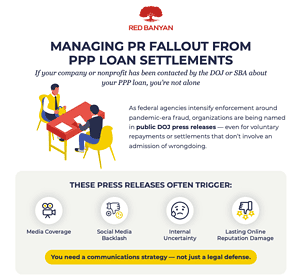
Even if an organization does not admit wrongdoing, the reputational impact can still be serious. A DOJ press release can trigger media coverage, stakeholder doubt, donor concerns, partner anxiety, and a permanent brand risk that lives on Google for years.
So what should you do if your company’s name appears in a DOJ press release connected to a PPP loan repayment or settlement?
Get our clear, practical guide to managing reputational risk if your organization is named in a PPP-related enforcement action.

1. Don’t Assume Silence Will Protect You
Many organizations believe that if they stay quiet, the story will pass. That instinct often backfires.
Government press releases remain indexed, searchable, and shareable. They resurface during vendor due diligence, investor conversations, board recruiting, and online reputation checks. Even worse, if you do not respond, the DOJ narrative becomes the only narrative.
Solution: Issue a short, carefully written statement that provides context and positions the organization as accountable, cooperative, and forward-looking. This statement should reflect values and leadership, not defensiveness.
2. Prepare Your Internal Audiences First
A common mistake is focusing on external messaging while internal audiences learn about the situation through the news. Employees, board members, donors, partners, and other key stakeholders should not be surprised. When they are, trust erodes quickly and rumor fills the gap.
Solution: Distribute a confidential internal FAQ or talking points explaining what happened, what actions were taken, and what it means going forward.
3. Respond Proactively to Media Inquiries
Once a DOJ press release goes public, local outlets and trade publications may reach out. Ignoring them does not reduce coverage. It typically leads journalists to rely only on government language and public records. That is how neutral facts turn into negative framing.
Solution: Work with a PR firm to develop reactive statements and designate a spokesperson. Messaging should highlight cooperation, corrective actions, and forward-looking leadership. Avoid defensiveness or emotional reactions.
4. Monitor and Manage Online Conversation
Some of the most damaging narratives do not begin in mainstream media. They often start on social platforms or niche communities where speculation spreads quickly. A short DOJ press release can get copied onto forums, Reddit threads, or industry groups, sometimes with incorrect assumptions attached to it.
Solution: Use media intelligence tools, or partner with a reputation management firm, to track coverage, identify narrative risks early, and correct inaccuracies before they escalate
5. Have a Long-Term Plan for Reputation Recovery
A settlement does not need to define an organization permanently. The danger comes when the organization does nothing afterward and allows negative search results to dominate. In reputational terms, the public remembers what an organization did next.
Solution: Highlight your organization’s impact, corrective measures, and ethical commitments through future campaigns, thought leadership, and social proof. Rebuild trust through transparency and mission-aligned storytelling.
How PR Can Help During PPP Enforcement Fallout
A PPP-related DOJ press release creates a unique type of reputational risk. It involves government credibility, implied wrongdoing, permanent digital indexing, and potential amplification by third parties. Strategic PR support helps you control what happens next.
Public relations support during PPP enforcement may include:
- Message Control: Clear, disciplined language that reduces misinterpretation
- Media Strategy: Consistent responses across press inquiries and platforms
- Stakeholder Alignment: Internal messaging to employees, boards, donors, and partners
- Digital Reputation Management: Reducing long-term SEO impact of negative coverage
- Brand Repair Strategy: A communications roadmap that rebuilds credibility over time
If your organization has been contacted by the DOJ, SBA, or another federal agency about a PPP loan, you should assume the story may become public. The best time to prepare is before the headline appears.
Red Banyan has experience guiding organizations through high-stakes reputational threats, including government scrutiny, media exposure, and credibility risk events. We help clients develop messaging, respond to media, and protect long-term reputation.
Message us or schedule a call with our crisis communications expert to discuss a PPP enforcement communications strategy before public perception defines your story.
Frequently Asked Questions (FAQ)
Will the DOJ or SBA issue a press release about my PPP loan settlement?
In many cases, yes. The DOJ and SBA have publicly announced enforcement actions, repayments, and settlements as part of broader accountability messaging, including matters resolved under the False Claims Act.
Do I need a PR firm if I already resolved the legal side of the issue?
Often, yes. Legal resolution does not end reputational exposure. Press releases, media pickup, and online search results can continue to influence trust, partnership decisions, and stakeholder confidence long after the case is closed.
What should I do if I have already been named in a DOJ press release?
Act quickly. Prepare a statement, align internal stakeholders, and develop a media response plan. Delay increases speculation and gives others control of the narrative.
Can I get a DOJ press release removed or de-indexed?
In most cases, official DOJ or SBA releases cannot be removed. However, PR professionals can reduce visibility through strategic content development, positive media coverage, and long-term search results management.
How fast should I respond if my name is made public?
Ideally within 24 hours. Early response shows leadership, minimizes speculation, and allows you to help frame how the story is told — rather than reacting to it after it’s been interpreted by others.