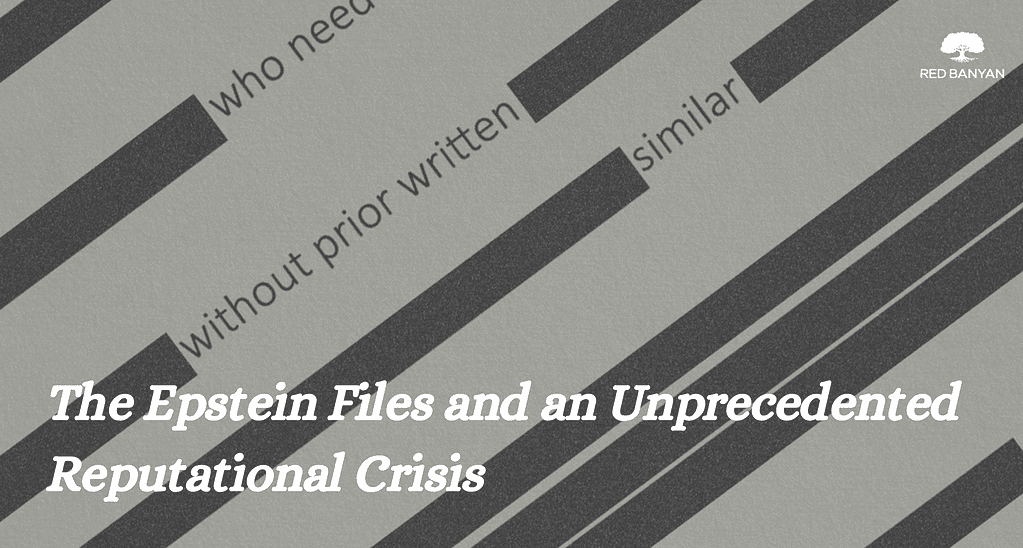

Jeffrey Epstein continues destroying reputations long after his death. The January 2026 release of three million pages of Department of Justice documents has created an unprecedented reputational crisis for thousands of high-profile individuals, from politicians, to business executives, to academics.
Thousands of names now publicly appear in this searchable online database. Some are connected to genuine crimes, others mentioned in forwarded emails, party invitations, or Ticketmaster marketing messages. The problem? Public perception rarely distinguishes between the guilty, the adjacent, and the completely random. The mere proximity to a monster can obliterate careers, regardless of actual wrongdoing.
The Crisis No One Was Prepared For
“Unless your brand is depravity and disgrace, you’ll want to stay as far away from the name Jeffrey Epstein as humanly possible,” says Evan Nierman, founder and CEO of Red Banyan. “Even from beyond the grave, he continues to ensnare people in reputational kryptonite. Any association with him is bad, full stop.”
Nierman’s assessment comes from years of crisis management experience, but the Epstein files present something entirely new: a permanent digital record that scrambles innocent proximity with genuine wrongdoing, creating a reputational minefield where context gets lost in clickbait headlines.
The Casey Wasserman Case
Casey Wasserman discovered this the hard way. The chairman of the LA28 Olympic organizing committee and head of a major Hollywood talent agency that bears his last name saw salacious 2003 email exchanges with Ghislaine Maxwell surface in the files, triggering immediate client defections.
Grammy winner Chappell Roan dropped the agency, followed by Country artist Orville Peck and rapper bbno$. Soccer legend Abby Wambach announced her departure days later. By mid-February 2026, Wasserman had stepped down from agency leadership, though the Olympic committee backed his LA28 role.
Wasserman issued a statement expressing “deep regret” for correspondence that occurred “over two decades ago, long before her horrific crimes came to light.” His case illustrates a crucial reality: when you’re high-profile with documented communications, staying quiet isn’t viable.
The Counterintuitive Crisis Strategy
Traditional crisis management advocates transparency and getting ahead of stories. The Epstein files require a different playbook entirely.
“Most people should do and say nothing,” Nierman explains. “Let the focus be those who are high-profile, clickbait-worthy celebrities, who actually have serious allegations to contend with. There’s very little to be gained for proactively going out and talking about yourself in the context of Jeffrey Epstein, just because you happen to be in these files.”
The reasoning defies conventional wisdom but makes perfect sense: voluntarily connecting your name to Epstein, even to proclaim innocence, creates search engine results and lasting associations that wouldn’t exist otherwise. You essentially write the damaging headline yourself.
What Companies Are Facing
Organizations from talent agencies to corporate boards are wrestling with unprecedented dilemmas. Firing employees based solely on file mentions risks unfair punishment. Yet keeping employees whose names appear alongside disturbing content poses reputational risks.
Red Banyan, a crisis management firm that specializes in handling cancel culture cases, advises clients to investigate context immediately, understanding exactly how and why names appear. Does the mention suggest actual wrongdoing or problematic judgment? Organizations must weigh their values against the court of public opinion, even when employees did nothing wrong.
The challenge grows more complex when you consider that many names remain redacted. Congressional representatives with access to unredacted versions have already revealed several names from the House floor. Each new revelation restarts the media cycle, keeping companies in a constant state of crisis readiness.
The Jon Stewart Exception
Jon Stewart addressed his appearance on The Daily Show, reading from an email where Epstein suggested Stewart host a Woody Allen special. His self-deprecating approach worked because his mention was clearly absurd and he has significant public goodwill.
But Stewart is the exception that proves the rule. For nearly everyone else, attempts at humor risk trivializing serious matters and can backfire spectacularly. The comedian has a platform, perfect comedic timing, and an obviously innocent mention. Most people have none of those advantages.
Keeping Perspective
Any discussion of reputation management must acknowledge real victims who suffered horrific abuse. The media circus around celebrity names can obscure this fundamental truth.
Crisis communications strategies exist to protect innocent people swept up in the document dump, not to rehabilitate those who enabled or participated in trafficking and abuse. This distinction matters profoundly. Red Banyan helps people explain innocent associations but doesn’t help people escape consequences for harmful actions.
The New Reality of Digital Association Risk
The Epstein files represent a new model of reputational crisis. Massive data dumps create guilt by proximity, where search algorithms become judge and jury. We’ll likely see this pattern repeat as other investigations produce document troves.
The Epstein files will remain searchable for decades, resurfacing with each new investigation or documentary. Understanding how to manage that ongoing risk, and crucially when to stay silent, may be the difference between weathering the storm and becoming its next casualty.
For those innocently mentioned, the path forward requires careful crisis navigation and often professional guidance. For those with genuine involvement, no amount of PR can or should erase accountability.
Frequently Asked Questions
My name is in the Epstein files. What should I do?
The answer depends entirely on context. If your mention is incidental (a marketing email, a forwarded article, attendance at a large event), then strategic silence is almost always the best approach. If you have documented correspondence or substantive connections, you may need professional crisis communications guidance to determine if and how to respond.
Should I issue a statement if I’m mentioned in the Epstein files?
In most cases, no. Issuing a statement draws attention to something most people don’t know about and creates permanent search engine results linking your name to Epstein. The exceptions are narrow: you’re already facing major media coverage, your public role makes silence look like guilt, or you can affirmatively prove innocence with documentation that changes the narrative.
What should companies do when employee names surface in the Epstein files?
Companies should investigate context immediately, assess whether mentions suggest actual wrongdoing versus innocent proximity, and consider their organizational values and public profile. The calculation differs dramatically for a children’s charity versus a tech startup. Prepare for worst-case media scenarios, even if internal investigations clear employees of wrongdoing.
Can I joke about being in the Epstein files?
Almost certainly not, unless you’re a professional comedian with a platform and an obviously innocent mention. For everyone else, humor risks trivializing serious matters involving real victims. What seems like a lighthearted way to defuse tension can backfire and create new reputational damage.
Should I be worried about redacted names being revealed later?
If you had any connection to Epstein, the answer is yes. Pressure continues building to un-redact names, and congressional representatives have already revealed several from the House floor. Assume redacted information may eventually become public. Prepare crisis communications materials now while not under immediate scrutiny, and retain counsel who can respond immediately if needed.
I’ve been mentioned in the Epstein files and it’s affecting my reputation. What are my options?
Start by monitoring and documenting all coverage. Handle concerns from business partners through private outreach with full context. Only consider public statements when silence causes more damage than speaking. Legal action should be a last resort for demonstrably false and damaging reports. Most importantly, consult with experienced crisis PR professionals who can assess your specific situation.
How can I protect my reputation in a world of searchable document dumps?
Exercise extraordinary care about professional associations, event attendance, and what lists or databases include your name. Document interactions, keep records of when you learned troubling information about associates, and avoid situations where you might be photographed with controversial figures. While exhausting, this vigilance represents the new reality of digital reputation management.
Need expert guidance on reputation management related to the Epstein files or other crisis situations? Red Banyan specializes in navigating complex reputational challenges with strategies tailored to your specific circumstances. Contact us now or schedule a free confidential consultation.